

Last updated October 16, 2026
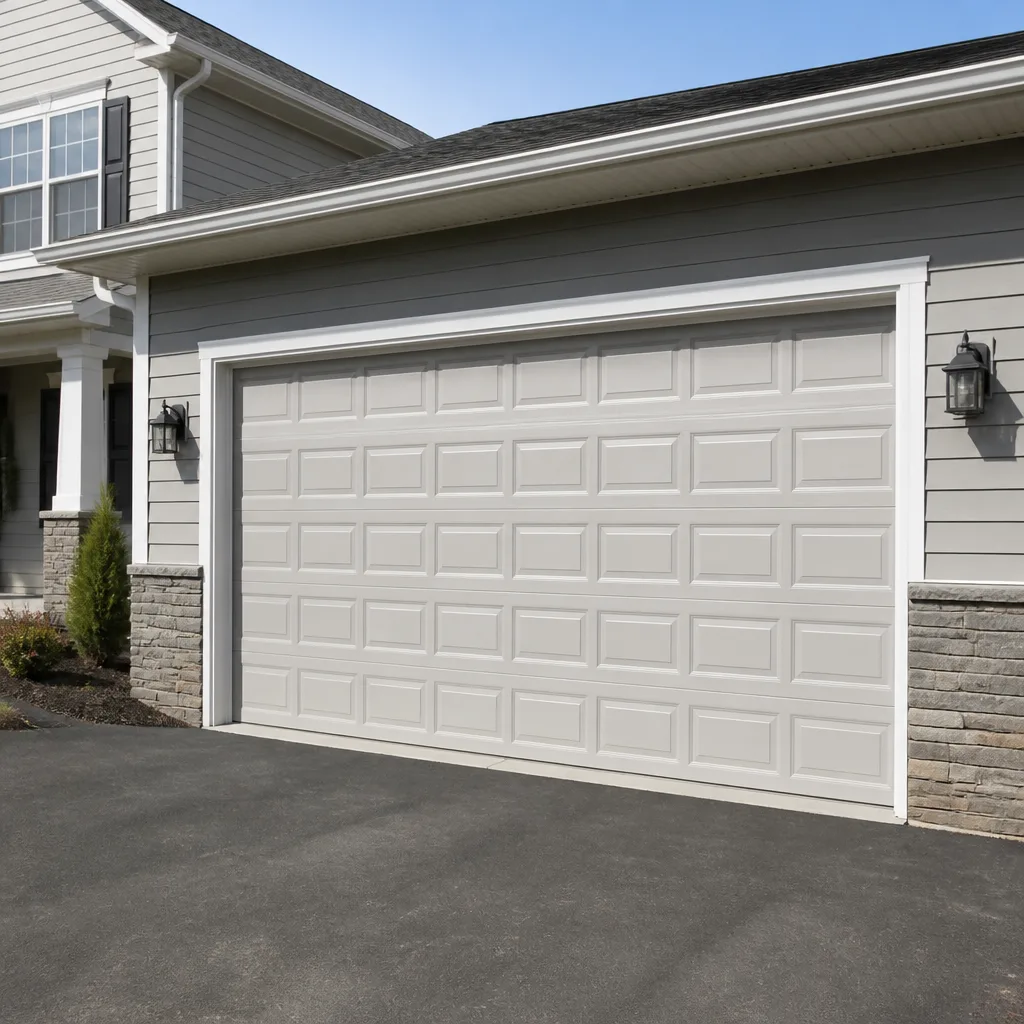 Raised-panel steel
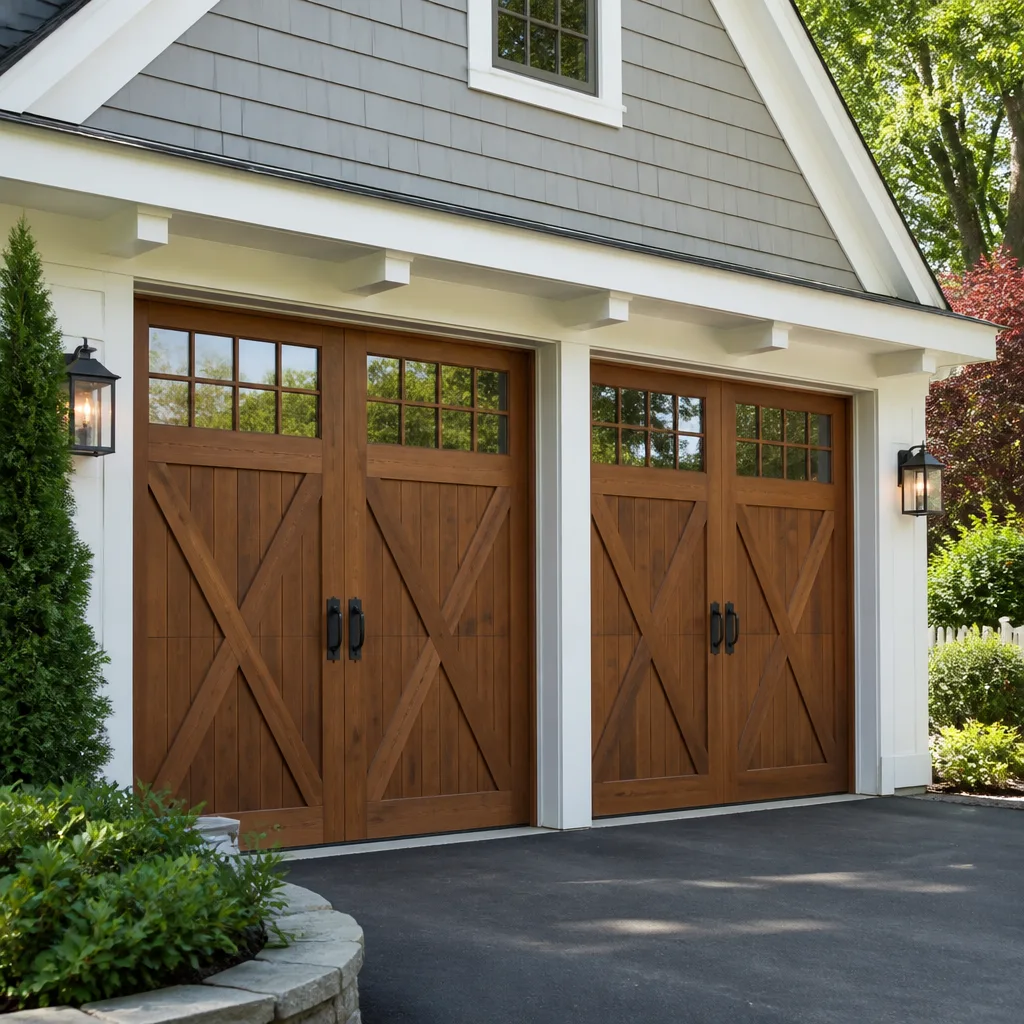 Carriage house
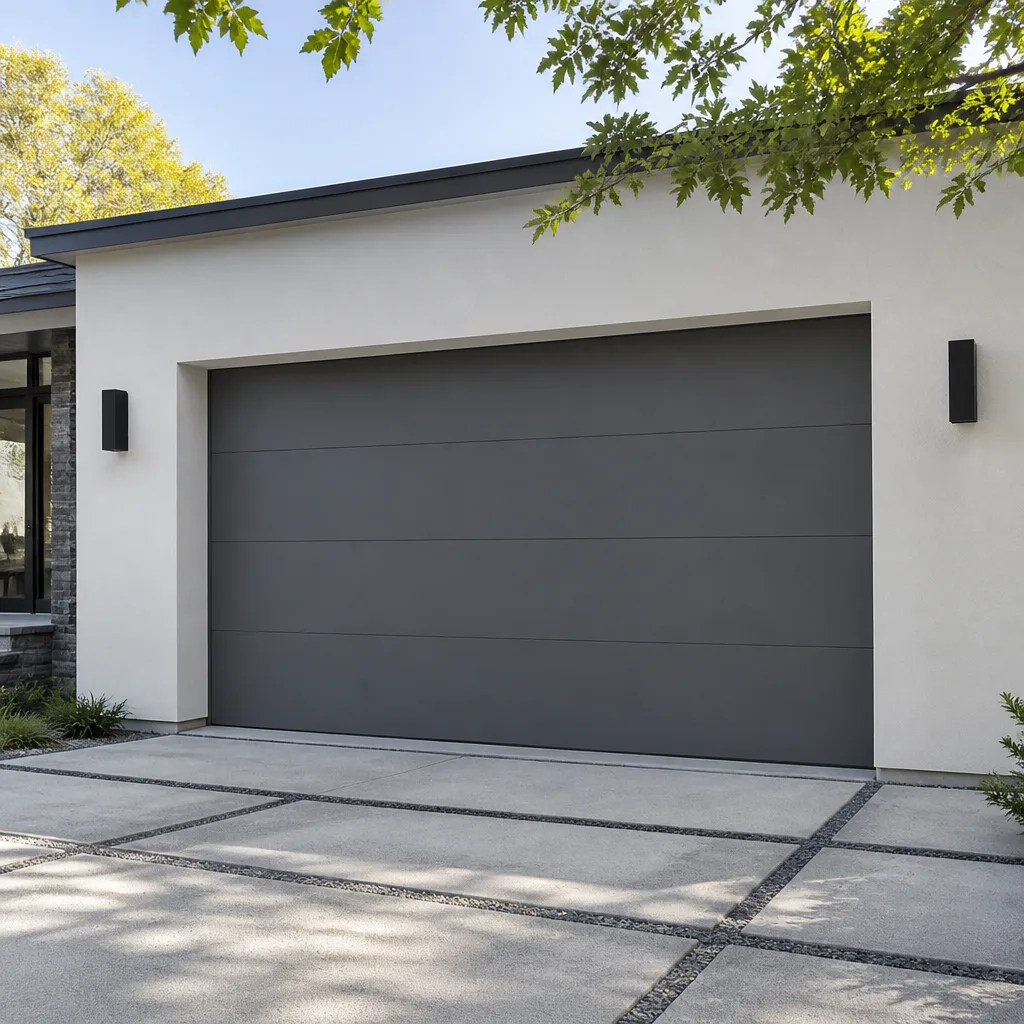 Modern flush
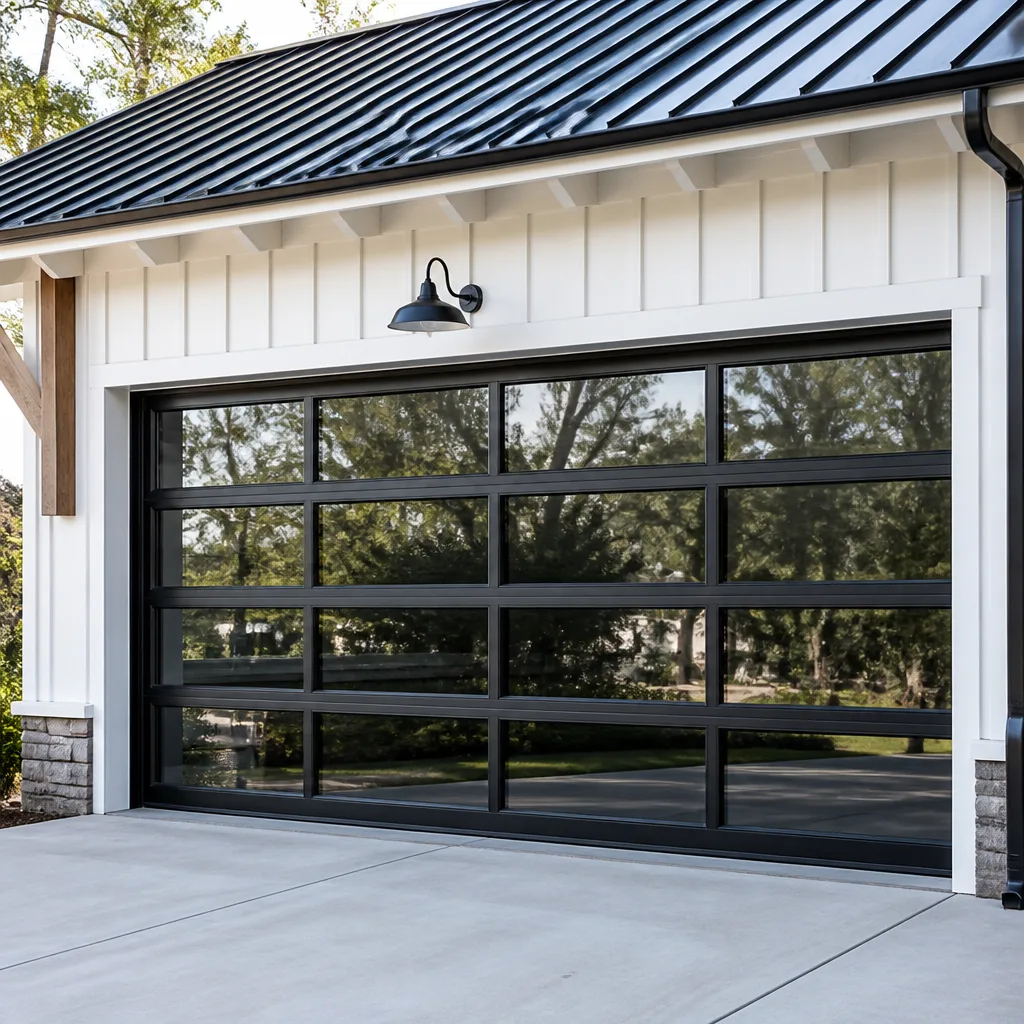 Full-view glass
 LiftMaster openers
 Chamberlain openers
Full 25-point door and opener safety check with every visit - springs, cables, rollers, tracks, and your LiftMaster or Chamberlain opener included
You get a price before we start. It does not change when the truck arrives.
Get your free estimateGarage Door Repair Maintenance Checklist for Houston Homeowners
Most emergency garage door calls we run in Houston happen within six weeks of peak summer heat. Not because the doors are old. Not because they were installed wrong. Because nobody checked the one component that August temperatures destroy first: the torsion spring. Heat accelerates metal fatigue, and in a city where the garage routinely hits 110 degrees inside, that spring is under stress no four-season maintenance guide ever accounts for. This checklist is built for Houston’s actual climate calendar, not a generic quarterly template. You’ll learn what to check in April and August, which lubricants survive Houston humidity, how to test your safety sensors in under four minutes, and which DIY tasks will quietly void your warranty.
Quick Answer
A Houston garage door maintenance checklist should prioritize two windows: April, when humidity spikes and hardware starts corroding, and July through August, when interior garage heat exceeds outdoor temperatures and stresses springs, cables, and opener electronics. Twice a year, lubricate springs and rollers with a silicone-based or lithium-based product that does not break down in high humidity, test the auto-reverse and photoelectric sensors, inspect weatherstripping for flood-line wear, and tighten all hardware. Most of this takes under 20 minutes.
Styles & brands we work with
Table of Contents
- The April Checklist: Preparing for Houston’s Humidity Onset
- The August Checklist: Surviving the Heat Peak
- How to Lubricate a Garage Door in Houston’s Humidity
- Testing Auto-Reverse and Photoelectric Sensors in Under Four Minutes
- Weatherstripping: The Flood-Line Inspection Houston Needs
- Warranty-Voiding Mistakes and How to Document Your Work
- Hardware Tightening and Track Inspection
- A Houston Maintenance Schedule That Actually Works
The April Checklist: Preparing for Houston’s Humidity Onset
April is when Houston’s relative humidity starts climbing past 80 percent on a regular basis, and that changes how every metal part on your garage door behaves. Bare steel begins a slow oxidization process. Grease thins. Rubber stiffens unevenly. If your garage door squeaks more in April than it did in February, that’s not the door telling you it’s old. It’s the hardware reacting to moisture.
Here’s what to check in April, in order:
- Inspect the torsion spring for rust bloom. The torsion spring, the thick coiled spring mounted above the door that bears most of the lifting load, should be clean metal with a thin coat of lubricant. If you see orange-brown speckling, the spring has begun to corrode. That does not mean immediate failure, but it does mean the spring’s fatigue life is shortening. Rust pitting creates stress concentrations, and that is where springs snap.
- Clean the tracks. Track buildup in Houston is different from track buildup in Dallas or Phoenix. Houston air carries fine particulate that mixes with humidity into a paste. Wipe both vertical tracks with a dry rag, then a rag lightly dampened with mineral spirits. Do not grease the tracks. Grease on tracks collects more paste.
- Check hinges and rollers for dark residue. Dark gummy residue on hinges means the previous lubricant has mixed with humidity and started breaking down. That residue is abrasive. It needs to come off before new lubricant goes on.
- Run the door through a full open-close cycle with the opener disengaged. Pull the red release cord and operate the door by hand. It should move smoothly through every foot of travel. If it binds, hesitates, or shifts sideways, that’s a balance or track problem, not a lubrication problem. Do not ignore binding in April. By August it will be worse.
- Look at the weatherstripping along the bottom edge and sides. More on this in the flood-line section below, but April is the month to catch cracks before tropical storm season starts in June.
If the April checklist reveals a spring already rust-pitted or a door that binds halfway up, call a Houston garage door company before the heat hits. The repair is smaller and cheaper in April than it will be in August. For context, Garage Door Repair in Houston typically runs most homeowners $150 to $350 for common fixes, and catching a problem early usually lands on the lower end of that range.
The August Checklist: Surviving the Heat Peak
By late July, the inside of a closed Houston garage sits between 10 and 20 degrees hotter than the outdoor temperature. On a 98-degree afternoon, that means 110 to 118 degrees inside. Steel expands. Grease evaporates its lighter fractions. Circuit boards in openers run near their upper thermal limit. And the torsion spring, under constant tension, is now hot metal working at a molecular disadvantage.
August is when we see the most spring failures and the most opener board failures in Houston. Here’s the August-specific checklist:
- Re-inspect the torsion spring for gaps. Hold a flashlight at an angle to the spring coil. A torsion spring that will fail soon often develops a visible hairline gap in the coil before it snaps. If you see a small gap between two coils that isn’t just spacing, that spring is compromised. Do not touch it. Do not attempt to tighten or adjust anything. Call a professional. A spring under load carries enough stored energy to cause severe injury or death.
- Feel the opener motor casing after a full cycle. If the motor case is too hot to keep your hand on for three seconds after running the door once, the opener is running beyond its designed thermal range. A too-hot opener in August often means the motor is drawing extra amperage to compensate for a door that isn’t balanced. That heat shortens the circuit board life. If you notice this, have the door balance checked.
- Listen for a change in the door’s sound. A door that operated quietly in May but groans or pops in August is telling you something. Heat expands the metal track slightly. If the track was aligned at the edge of tolerance, that expansion is enough to cause binding. Binding burns out opener motors.
- Check the emergency release cord for heat stiffness. The nylon release cord gets hot. If it feels stiff or brittle, it’s aging. Replacement is cheap. Replacement during an emergency when the cord snaps is still cheap, but the timing is worse.
- Test the auto-reverse one more time. More on this below. In August, do not skip this.
We’ve run August service calls in neighborhoods across Houston where the failure point wasn’t the door. It was the opener’s logic board, cooked inside a hot garage with no ventilation. If your garage has no vents and no insulation on the door, consider adding passive ventilation. Even a pair of small louvered vents in the garage wall drops interior temperatures by 10 to 15 degrees on the hottest days. That extends the life of every part attached to the door.
How to Lubricate a Garage Door in Houston’s Humidity
The wrong lubricant in Houston turns into glue. WD-40 is the most common mistake we see. WD-40 is a solvent and water displacer, not a long-term metal lubricant. Spray it on garage door rollers or springs and it will strip off existing lubricant, then evaporate, leaving bare metal in 80 percent humidity. That bare metal rusts. The door gets noisier, not quieter.
For Houston’s climate, use one of two product types:
- Silicone-based spray lubricant labeled specifically for garage doors. This dries to a thin, non-tacky film that does not attract Houston’s airborne dust. It works well on nylon rollers, hinges, and the torsion spring. A can runs $10 to $20.
- White lithium grease in a spray or tube. This is heavier than silicone and lasts longer on metal-to-metal contact points. Use it on the torsion spring and on the bearing plates at the ends of the spring shaft. Do not use it on nylon rollers; it’s too heavy and collects debris.
Do not use motor oil, vegetable oil, penetrating oil, or anything labeled “multi-purpose lubricant” unless it specifies silicone or lithium. Multi-purpose usually means petroleum-based, and petroleum-based lubricant degrades fast in Houston humidity. By the third week it’s a sticky layer of degraded hydrocarbons mixed with whatever came through the garage door.
Here is the lubrication sequence we teach Houston homeowners:
- Wipe first. Remove old lubricant and grime from the spring, hinges, and roller stems with a clean rag. Lubricant applied over old gunk seals the gunk in and accelerates wear.
- Spray the torsion spring. Apply an even coat to the entire visible length of the spring. Do not drench it. A light, even film is correct. Too much lubricant drips onto the door surface and collects dust.
- Lubricate hinges. Two small sprays on each hinge pivot point, both sides of the door. That’s 12 to 16 hinges on most two-car doors.
- Lubricate roller stems, not the roller wheels. The stem is where the roller meets the hinge. The wheel itself rides on the track and should stay dry. If your rollers are nylon, a tiny amount of silicone on the stem is all they need. If they’re steel rollers, one small drop of lithium grease on the stem bearing.
- Run the door once. Full open and close. This works the lubricant into the bearing surfaces.
- Wipe any drips. Lubricant on the floor of a Houston garage in summer becomes a slick spot. Clean it up.
How often? Twice a year in Houston, timed to the April and August checklists. Once in early April when humidity ramps up, once in late July before the worst heat. If your garage faces south or west and gets direct afternoon sun on the door, do it three times a year. The extra heat on that door face breaks down lubricant faster.
Testing Auto-Reverse and Photoelectric Sensors in Under Four Minutes
Federal law has required automatic reverse systems on residential garage door openers since 1993. The photoelectric sensors, the two small units mounted four to six inches off the floor on either side of the door opening, became mandatory at the same time. Both systems exist to stop the door from closing on a person, pet, or object. Both systems fail silently. And in Houston, where the heat and humidity stress electronic components year-round, they fail more often than the national average.
Here’s the four-minute test sequence, done in order:
- Test the photoelectric sensors first. With the door fully open, press the close button. As the door begins to descend, wave your foot through the path between the two sensors. The door should stop and reverse immediately, returning to the open position. This confirms the sensors are aligned, powered, and communicating with the logic board.
- Test the auto-reverse mechanical function. Close the door. Place a block of scrap wood, a roll of paper towels, or a full two-liter bottle flat on the floor directly under the door’s path. Press the close button. The door should contact the object and reverse within two seconds of contact. If the door hesitates, pushes against the object, or does not reverse until the object is crushed, the force setting is wrong.
- Watch the direction reversal without an obstruction. While the door is closing, press the wall button or remote button once. The door should reverse direction immediately. If the door continues closing for a fraction of a second before reversing, the logic board is lagging. That’s an early sign of a failing board, common in Houston garages where heat has taken a toll.
- Check the sensor LED indicators. Both sensor units have a small LED light. On most LiftMaster and Chamberlain openers made after 2010, both LEDs glow solid when aligned. One solid and one blinking, or both blinking, means misalignment or a wire fault. A door that reverses for no reason on the way down is almost always a sensor issue.
If the auto-reverse force test fails, if the sensors will not hold alignment, or if the door reverses direction mid-cycle for no reason, stop using the door. The opener needs service. A door that does not reverse on contact is dangerous enough that we recommend leaving it open and calling a professional same day. For Garage Door Opener Repair in Houston, Brock Garage Doors Houston quotes common opener repairs between $125 and $300 depending on the fault, and every quote is in writing before the first bolt turns. Wade Mercer and our Houston technicians test every safety system on every service call, no exceptions.
Weatherstripping: The Flood-Line Inspection Houston Needs
Most weatherstripping advice focuses on drafts and dust. In Houston, that advice misses the point. Houston’s ground-level flooding risk means your garage door’s bottom seal is doing a job no four-season climate ever asks of it. When water pools against a garage door during a heavy rain, the bottom seal is the only thing between that water and everything stored on the garage floor.
Here’s the visual inspection sequence:
- Close the door and look at the bottom seal from inside. The rubber or vinyl strip mounted along the bottom edge of the door should press firmly against the concrete slab along its entire width. Look for gaps where light comes through. In Houston, even a quarter-inch gap at the slab’s low corner is enough to let water seep in during a hard storm.
- Run your hand along the bottom seal’s length. Check for cracks, brittleness, or flattening. A seal that has been compressed for years loses its rebound. When a seal gets hard, it stops conforming to the slab’s uneven spots. That’s when water finds a path.
- Check the side and top weatherstripping. Look for tears, especially at the bottom corners where side seals meet the threshold. These bottom corners take the most abuse in Houston because that’s where water, leaves, and blown debris collect.
- Inspect the slab itself. This is a Houston-specific check. Over time, Houston’s expansive clay soil shifts, and garage slabs can develop low spots at the door line. If you see water pooling inside the garage after a normal rain, the problem may not be the seal. It may be the slab. In that case, a thicker bottom seal or a threshold seal strip glued to the concrete can solve the problem without slab work.
Bottom seal replacement on most Houston garage doors runs $75 to $150 installed. Side and top weatherstripping replacement runs $100 to $200. These are among the cheapest fixes you can do on a garage door, and they pay for themselves the first time a Houston downpour hits and the water stays outside.
Warranty-Voiding Mistakes and How to Document Your Work
Most garage door manufacturer warranties are specific about what voids them, and the list is shorter than you might think. But Houston homeowners make three specific mistakes that come up again and again in warranty disputes.
Mistake one: lubricating with the wrong product. If a spring fails and the manufacturer’s representative finds petroleum-based lubricant residue, that’s a legitimate basis for denying the claim. Manufacturers cite incompatible lubricant as a contributing factor. Use the silicone or lithium products described above, and keep the can or tube. The label is your documentation.
Mistake two: adjusting torsion spring tension themselves. This is not just dangerous. It’s an automatic warranty void on every major brand, including LiftMaster, Chamberlain, Genie, and Raynor. Any tampering with the spring’s winding cone, the set screws, or the tension setting means the manufacturer walks away from the claim. The same goes for any attempt to remove or reinstall the spring. If the spring needs adjustment, call a professional. If you touch it and something goes wrong later, you own the full cost of replacement.
Mistake three: replacing parts with non-OEM components. A generic spring or an off-brand opener logic board can void the warranty on adjacent parts. Manufacturers warranty their systems, not mixed assemblies. If you have a Chamberlain opener and the circuit board fails, replacing it with a no-name board from an online marketplace voids the warranty on the entire opener.
Documentation matters in Houston, where garage door failures cluster in summer and manufacturers sometimes push back on claims filed during peak failure season. Keep a simple log. Note the date, the task performed, the product used, and a one-sentence observation of the door’s condition. A written log even a few lines long, kept twice a year, is usually enough to support a warranty claim. Photograph the spring twice a year, April and August. If the spring fails and the manufacturer asks whether you performed maintenance, you have dated, visual proof.
One thing about documentation and guarantees: a written guarantee is only as good as the company behind it. At Brock Garage Doors Houston, every repair carries a written 365-day guarantee. If a covered repair fails within that window, we return and correct it at no charge. That guarantee is in writing on every job, not a verbal assurance. And documenting your own maintenance, even just the two annual checks described here, keeps your side of that relationship clean.
Hardware Tightening and Track Inspection
A garage door cycles open and closed roughly 1,500 times a year in a typical Houston household. Every cycle applies torque and vibration to every bolt, nut, and bracket on the door and track system. Over time, hardware loosens. A loose hinge bolt lets the door panel flex. A loose lag screw on a track bracket lets the track drift. A loose bolt on a roller stem lets the roller wobble, which accelerates track wear.
Twice a year, take a socket set and go through the hardware. Here’s the sequence:
- Door in the closed position. Check every hinge bolt where hinges attach to the door sections. They should be snug, not overtightened. Overtightening strip threads or crush the door material on lightweight aluminum doors.
- Track brackets. The vertical tracks are held to the wall framing with lag screws and brackets. Grab each bracket and try to wiggle it. Movement means the lag is loose or the bracket has pulled away from the wall. Snug loose lags. If a lag spins without tightening, the hole is stripped and the bracket needs a longer lag or a new location.
- Opener mounting hardware. Check the bolts holding the opener motor to the ceiling brackets and the bracket connecting the opener rail to the header above the door. These work loose faster than any other hardware on the system.
- Spring mounting pads. The torsion spring is anchored to a center bracket and two end bearing plates. Visually check for movement at these points. Do not put a wrench on the spring itself. If a spring mounting bolt is loose, leave it and call a professional. That spring is under load.
- Roller brackets. The roller brackets at the top of each side of the door carry the most load. Check the bolts on these brackets specifically. A loose top roller bracket causes the door to lean and the opener to work harder.
Track inspection is mostly visual. Stand in front of the closed door and sight down each vertical track. The two tracks should be parallel, the same distance apart top and bottom. Any bowing, spreading, or narrowing means the track has been hit or the wall has shifted. Houston clay soil moves, and when the garage wall moves, the track moves with it. If a track is visibly out of parallel, do not run the door. The rollers can bind, and a bound roller can tear out of the bracket. That’s a cable failure waiting to happen. Garage Door Cable Repair in Houston runs most homeowners $150 to $275 depending on cable type and drum condition, and it’s a repair that should be done by a professional, not attempted at home. Cables are under tension and the injuries from a snapped cable are serious.
A Houston Maintenance Schedule That Actually Works
Here’s the entire maintenance plan on one schedule. No quarterly reminders. No fifteen point monthly inspections. Two solid passes a year, timed to Houston’s climate, plus two one-minute checks you do when you notice the door acting differently.
The Full Pass: Early April
- Clean tracks and inspect for paste buildup
- Inspect the torsion spring for rust and pitting
- Lubricate spring, hinges, and roller stems with silicone or lithium
- Tighten all accessible hardware
- Inspect weatherstripping for cracks and flattening
- Test auto-reverse and photoelectric sensors
- Photograph the spring and log the maintenance
The Full Pass: Late July or Early August
- Re-inspect torsion spring for gaps and heat stress
- Check opener motor temperature after one cycle
- Lubricate again, especially on south- and west-facing doors
- Run the door by hand and listen for binding
- Re-test auto-reverse and sensors
- Check weatherstripping again before peak hurricane season continues
- Photograph the spring and log the maintenance
The One-Minute Checks: Whenever You Notice
- Door is noisier than it was last month
- Door hesitates or reverses without a visible obstruction
- Door hangs unevenly or sits crooked when closed
- Water appears inside the garage after rain
That is the whole system. Two thorough passes, four triggers for a closer look. It takes less than an hour total per year, and it catches the failures Houston throws at garage doors before they become emergencies.
Common Mistakes to Avoid
- Using WD-40 as garage door lubricant. WD-40 strips existing lubrication and leaves bare metal exposed to Houston’s 80-plus percent humidity. Bare metal rusts, and a rusted spring is a spring on borrowed time.
- Greasing the tracks. Tracks should stay dry. Grease on tracks collects airborne dust mixed with humidity into an abrasive paste that wears rollers and strains the opener. Clean tracks, dry tracks.
- Ignoring a door that reverses for no reason. A door that reverses mid-cycle or refuses to close is almost always a sensor alignment or wiring issue. Houston heat expands brackets and loosens wire connections. Leaving it unfixed means the door eventually stops working altogether, usually at the worst time.
- Touching the torsion spring. Every year, homeowners in Houston try to adjust garage door spring tension themselves after watching a video online. Every year, someone ends up in an emergency room. The torsion spring stores enough energy to sever fingers, break bones, or kill. Do not touch it. Call a professional.
- Skipping the auto-reverse test. It’s a four-minute test that has been required by federal law for over three decades, and most Houston homeowners have never done it. A door that does not reverse on contact is a serious safety hazard to every person and pet in the household.
- Replacing one spring when there are two. Most double-wide Houston garage doors have two torsion springs, one on each side. When one fails, the other is usually near the end of its life too. Replacing only the failed spring saves money up front and costs more within a year when the second one snaps. Replace both together.
- Ignoring a squeak because the door still opens. A squeak is metal dragging on metal. It means lubrication has failed or hardware has shifted. By the time the door stops opening, the repair is three times what it would have been at the squeak stage.
See the difference
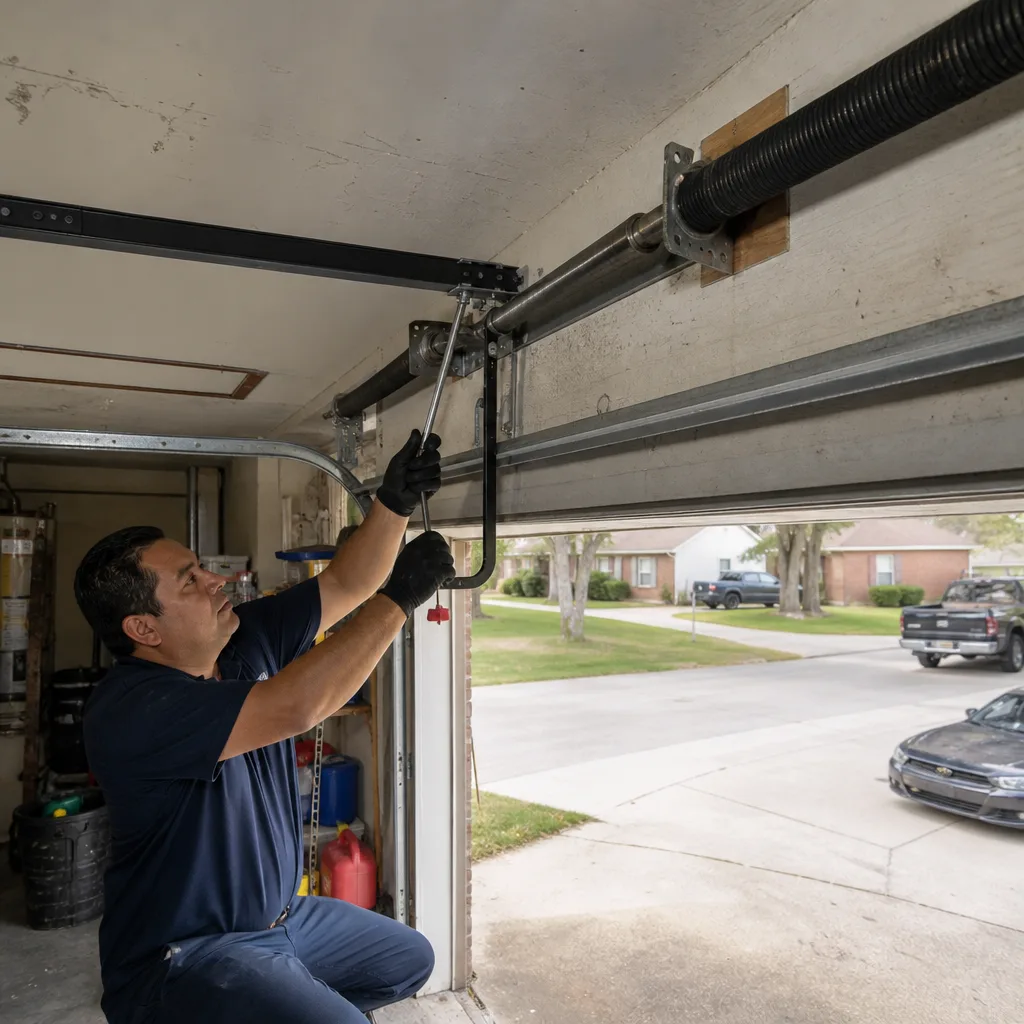 Before
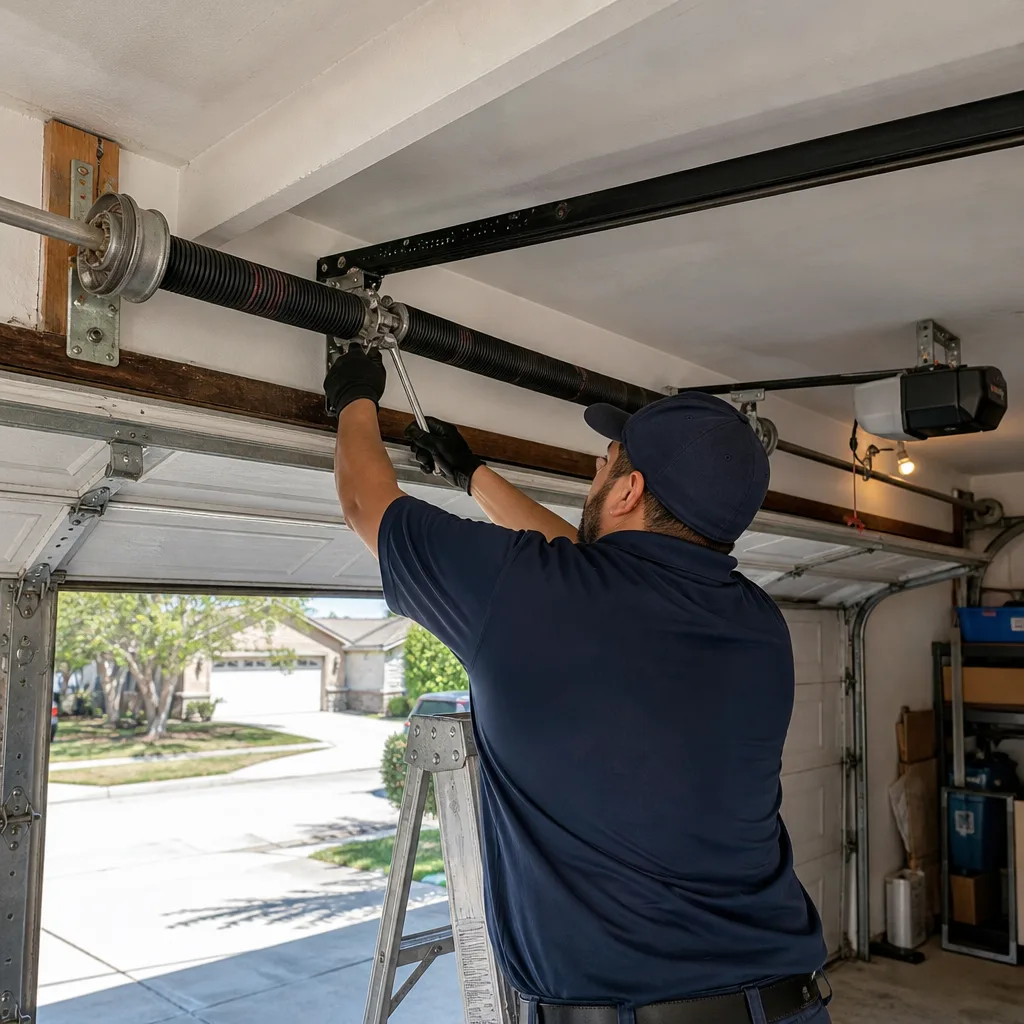 After
After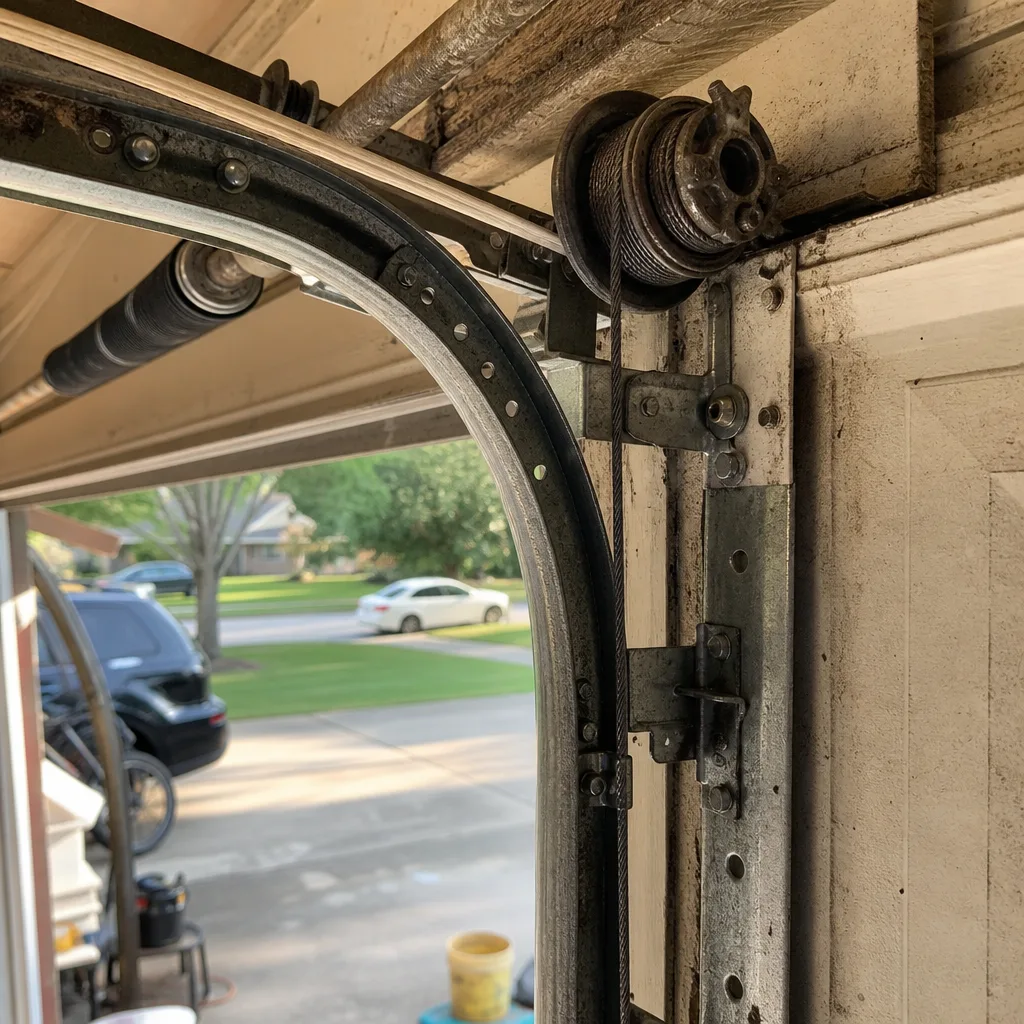 Before
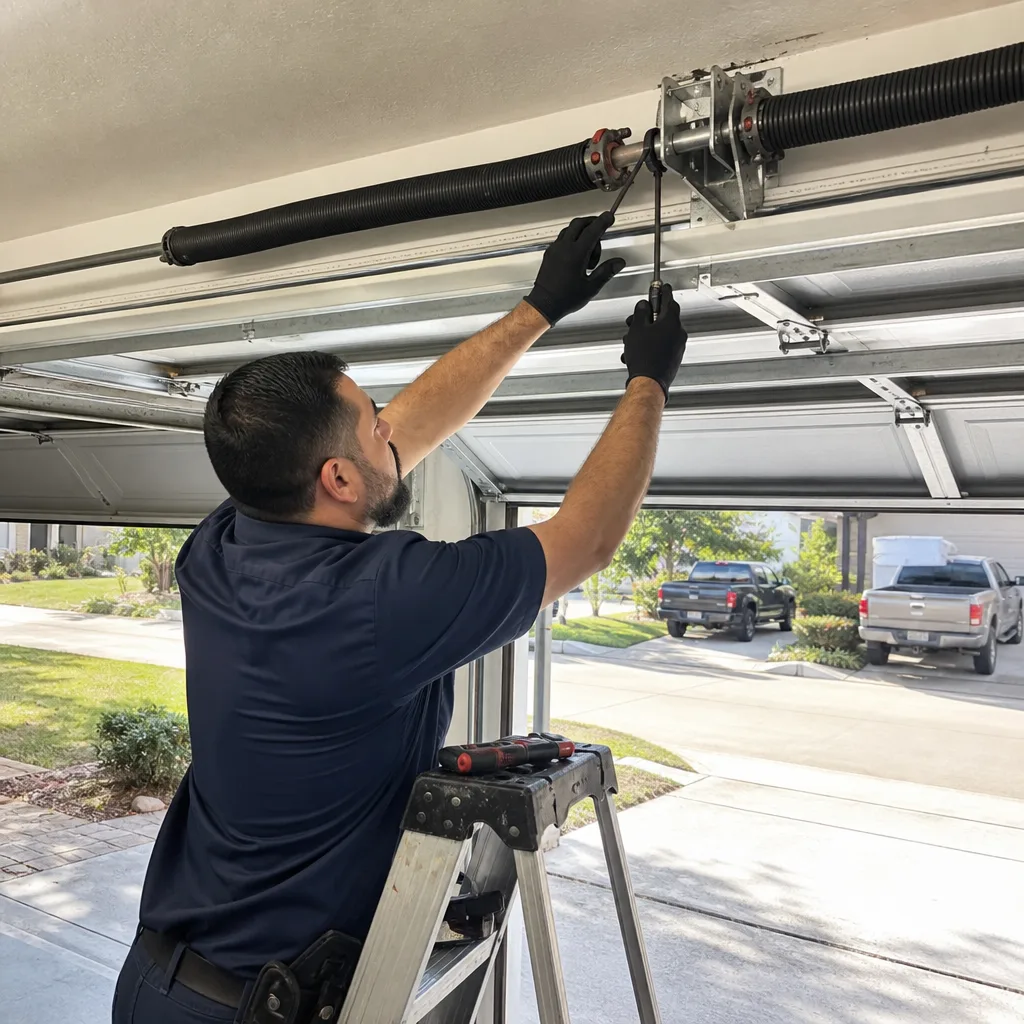 After
After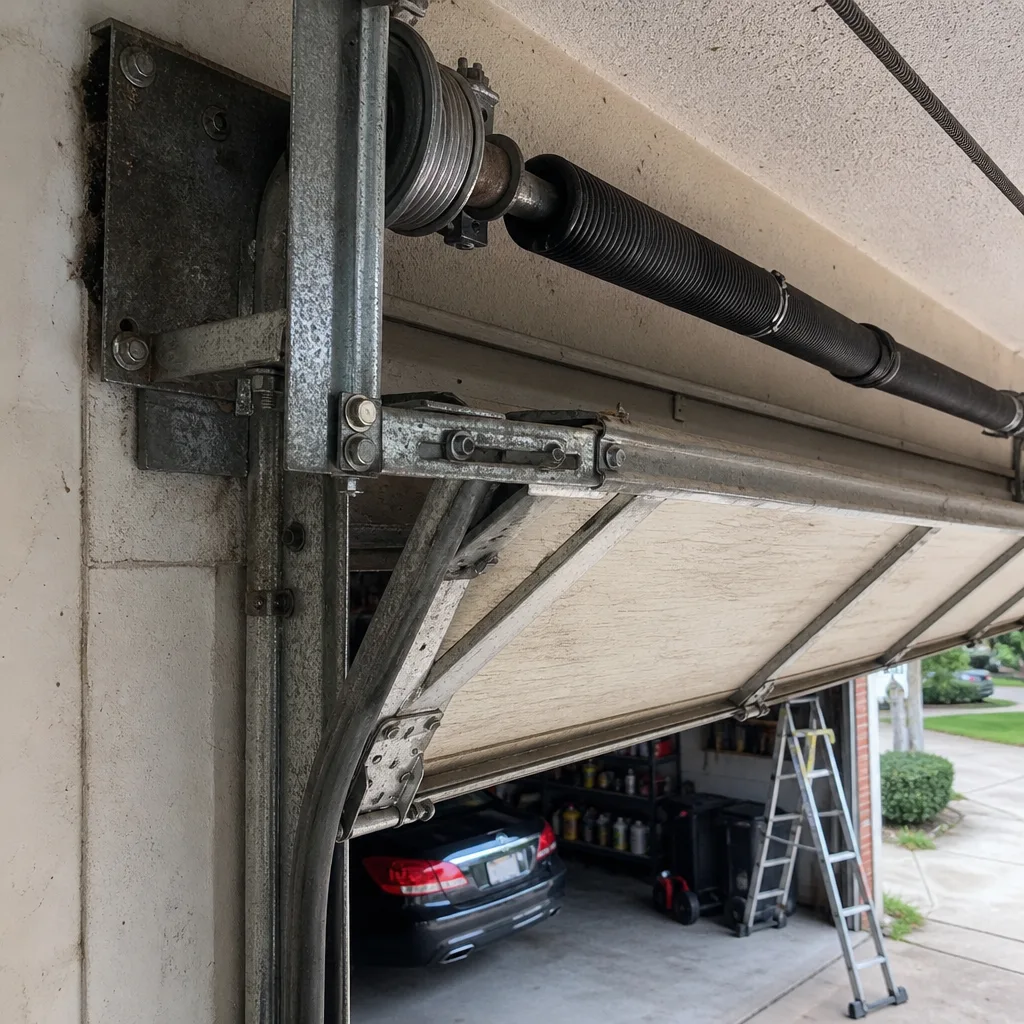 Before
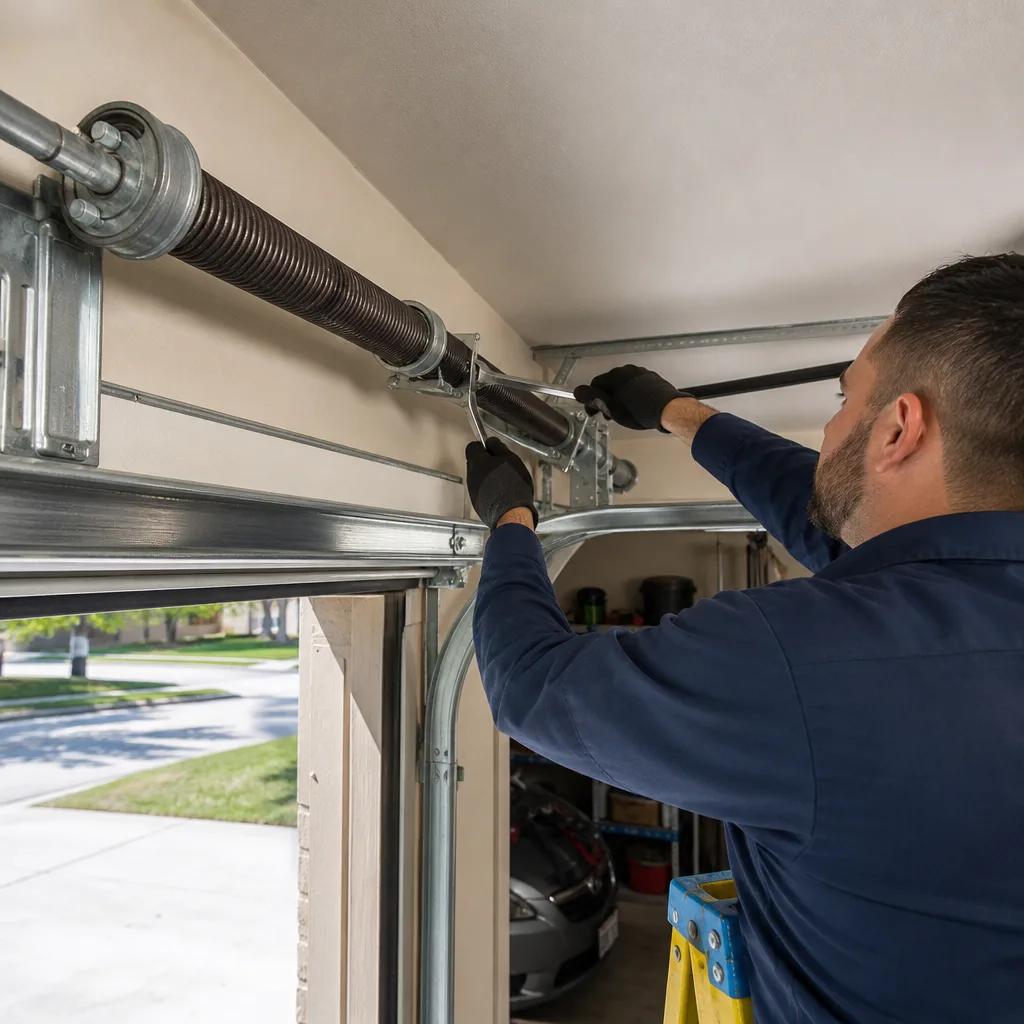 After
AfterWhen to Call a Professional
Some tasks are maintenance. Some are repair. The line between them is clear, and crossing it without the right training gets people hurt and damages doors. For a detailed breakdown of what to watch for, see our Garage Door Warning Signs: A Houston Homeowner’s Reference Guide. Call a professional if the torsion spring has a visible gap or rust pitting beyond light surface oxidation. Call if the door binds, jerks, or hangs crooked when you operate it by hand. Call if the auto-reverse test fails, if the photoelectric sensors won’t hold alignment, or if the opener motor runs hot enough to burn your hand. Call if a cable is frayed, kinked, or showing individual wire strands. And call if the door has come off its track, which is a job that requires releasing spring tension, not just pushing the door back into place.
Brock Garage Doors Houston offers our Garage Door Repair services with free estimates throughout the Houston area. Call (325) 308-2009 and a real person answers, day or night. The price is written down and handed to you before any work begins, and every repair carries the 365-day guarantee in writing.
Frequently Asked Questions
Twice a year in Houston, timed to early April and late July. Houston’s humidity and heat both degrade garage door lubricant faster than the national average, so the standard once-a-year advice does not hold up here. If your garage door faces south or west, lubricate a third time in mid-summer because direct sun on the door face bakes the lubricant off faster.
Use a silicone-based spray or white lithium grease specifically labeled for garage doors. Both resist breakdown in Houston’s high-humidity environment. Do not use WD-40, motor oil, or any petroleum-based multi-purpose spray. These products break down quickly in humid air and leave a sticky residue that attracts dust. A proper garage door lubricant costs $10 to $20 at any Houston hardware store.
A garage door that reverses mid-cycle is usually reacting to a photoelectric sensor fault. Houston’s heat and humidity cause sensor brackets to shift, wires to loosen, and LED alignment indicators to misread. The sensors may be misaligned, dirty, or failing entirely. Clean both sensor lenses with a dry cloth and check the LED indicators. If both lights aren’t solid, the sensor system needs adjustment or repair. Call (325) 308-2009 if the problem persists; Brock Garage Doors Houston carries sensor parts on the truck for most LiftMaster, Chamberlain, and Genie openers.
A DIY maintenance pass using a $15 can of lubricant and a rag costs less than $20. A professional tune-up from a Houston garage door company typically runs $75 to $150, which includes lubrication, hardware tightening, safety system testing, and a written inspection. At Brock Garage Doors Houston, the price you’re quoted before the work starts is the price on the invoice, and maintenance calls carry the same written 365-day guarantee as repairs. Call (325) 308-2009 for an exact quote; estimates are free.
Yes. Garage door torsion springs are rated for a certain number of cycles, and heat accelerates the fatigue that reduces that rating. A spring inside a 110-degree Houston garage is hotter than the spring was designed to run at on a continuous basis. Heat also thins lubricant, increasing friction on the spring coils. The combination means Houston springs fail earlier than identical springs in cooler climates, which is why the August spring inspection matters so much.
Yes, in almost every case. Double-wide garage doors in Houston typically have two torsion springs installed at the same time, and they wear at the same rate. If one has snapped, the other is close behind. Replacing both together costs more than replacing one, but it’s cheaper than two separate service calls and avoids the inconvenience of a second failure within months. A professional garage door company will quote both springs as a set and explain the math before any work begins.
The Bottom Line
Houston garage doors fail on a predictable schedule. The humidity spike in April corrodes hardware and breaks down lubricant. The heat peak in August stresses springs and cooks opener electronics. A maintenance routine built around those two windows, rather than a generic quarterly checklist, catches most failures before they happen. Lubricate correctly with silicone or lithium, test the safety systems twice a year, inspect weatherstripping before flood season, and never touch a torsion spring yourself. The entire plan takes less than an hour per year. If a problem falls outside the maintenance line, call Brock Garage Doors Houston at (325) 308-2009. A real person answers, the price is in writing before work starts, and every repair is covered for 365 days.
Written by Wade Mercer, Owner at Brock Garage Doors Houston, serving Houston since 2001. Explore more guides & resources on our blog.