

Last updated October 16, 2026
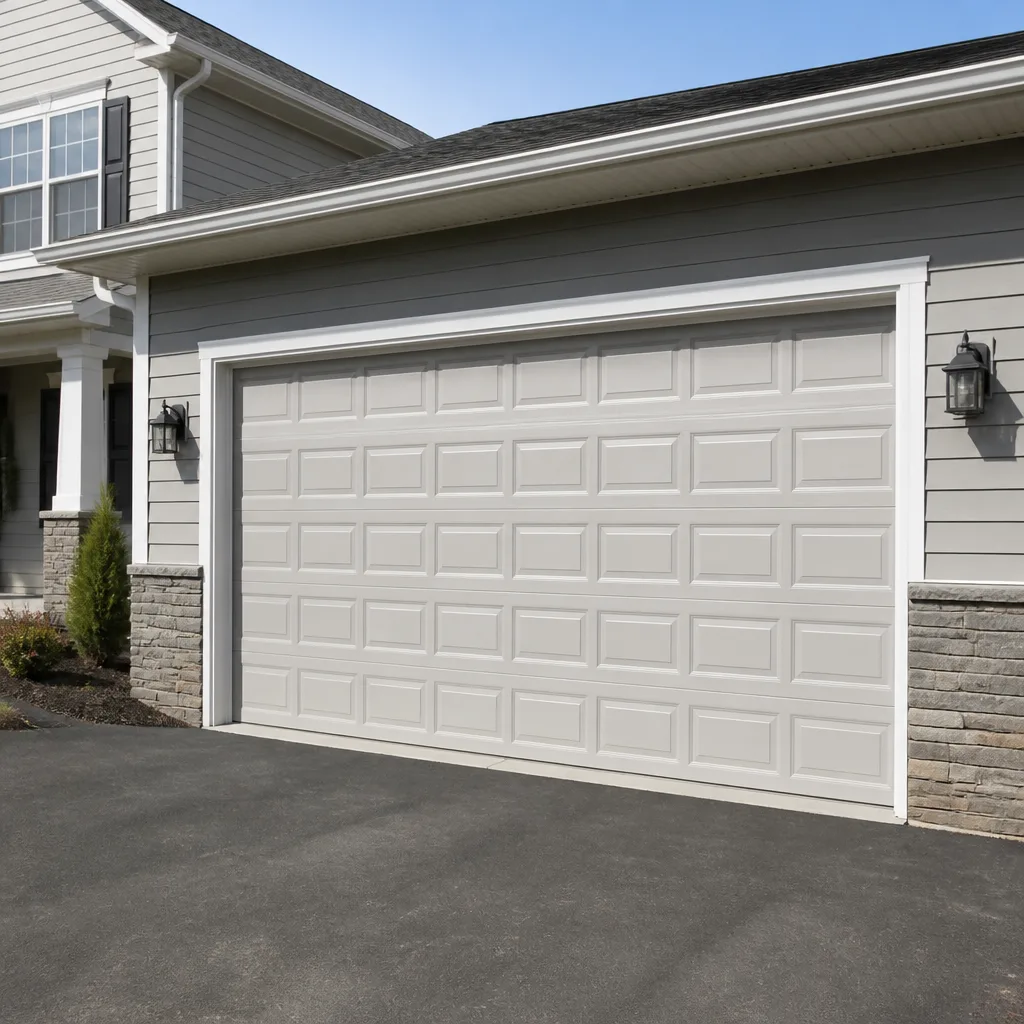 Raised-panel steel
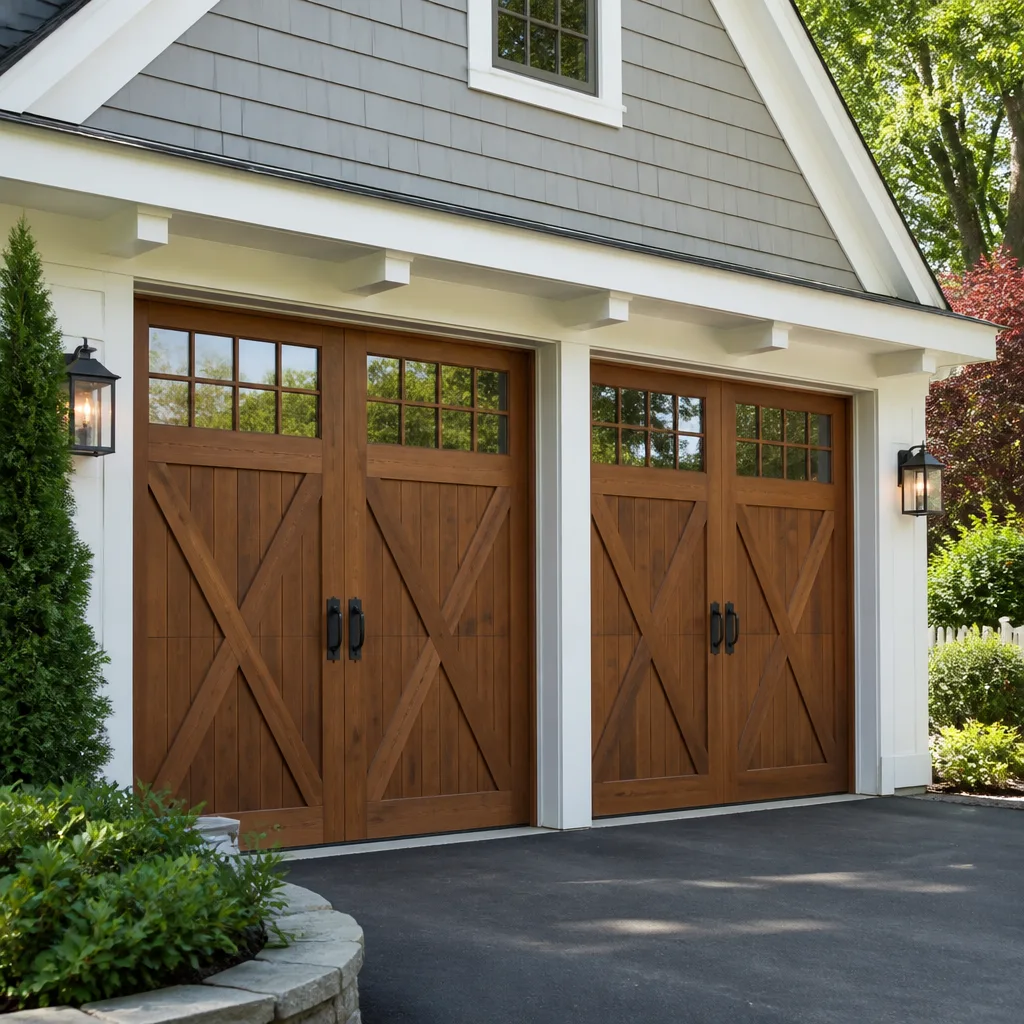 Carriage house
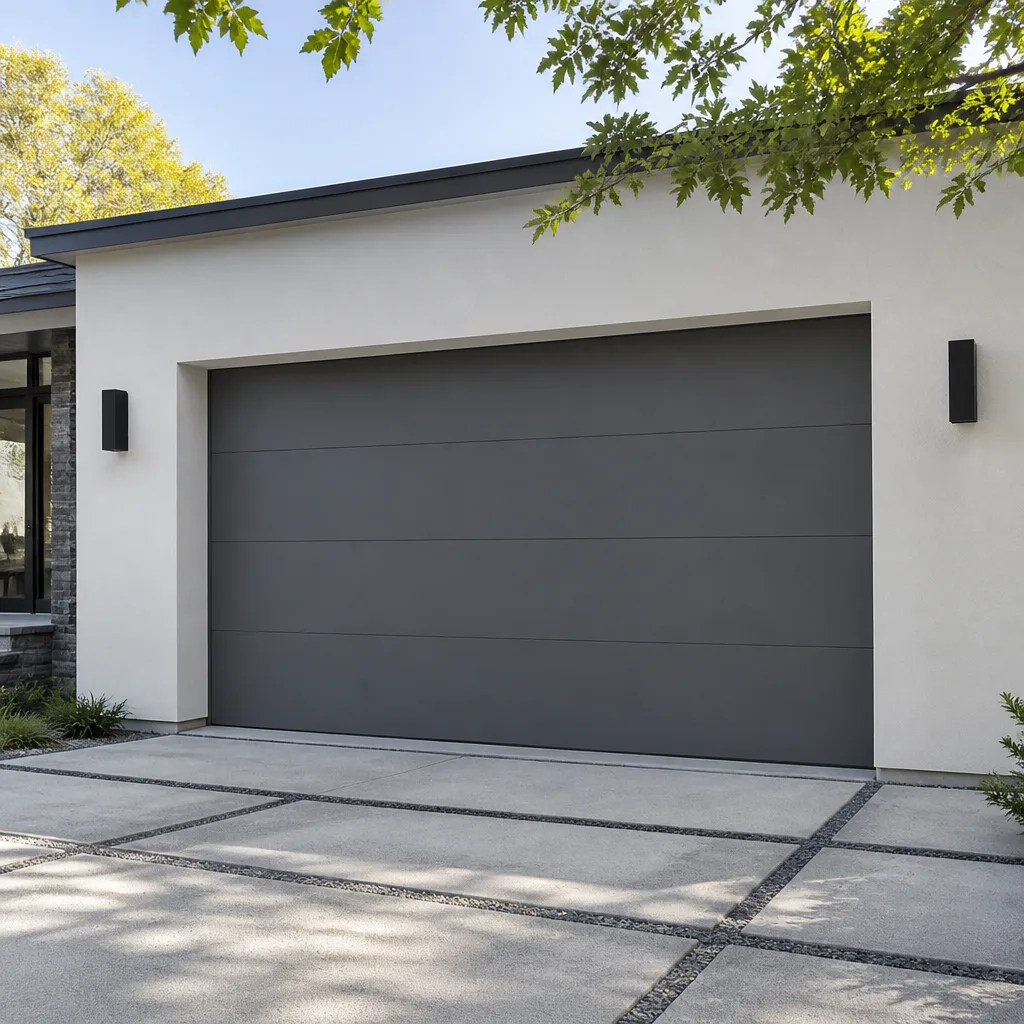 Modern flush
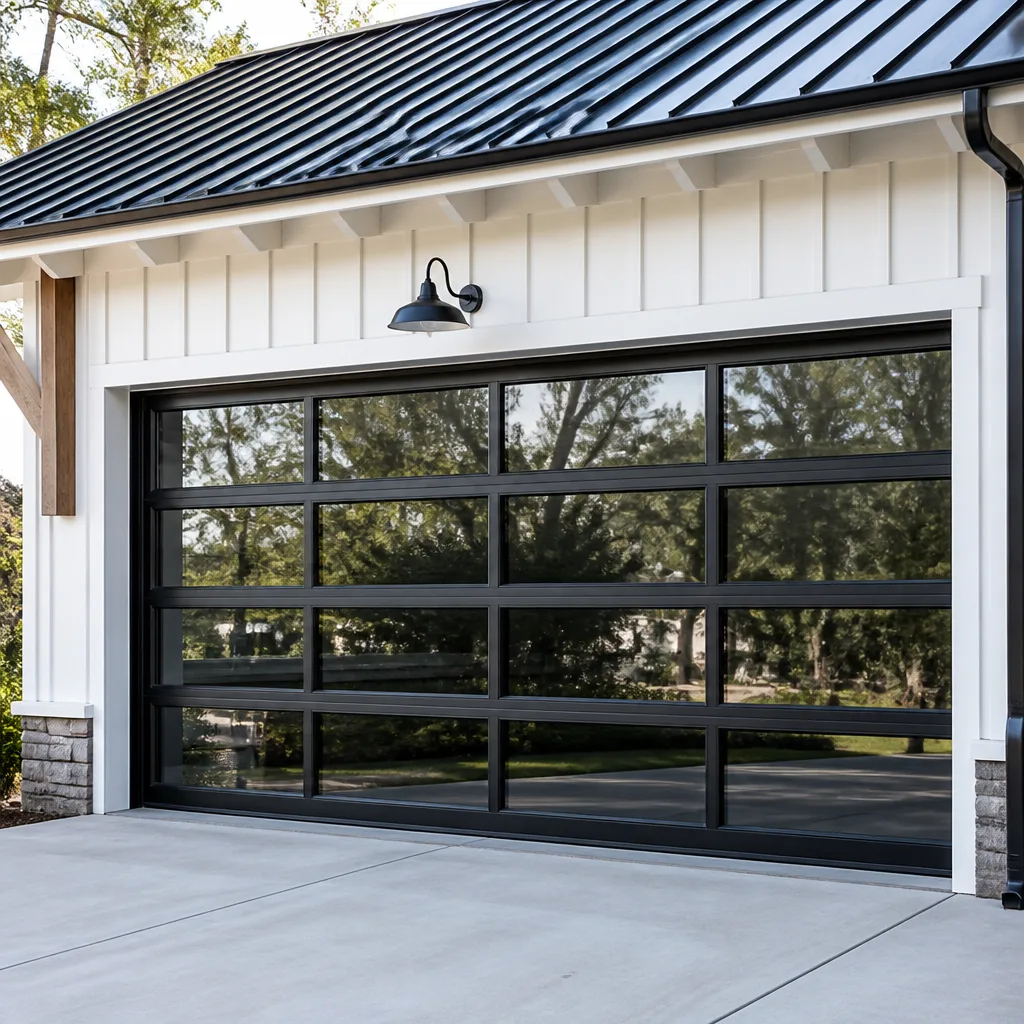 Full-view glass
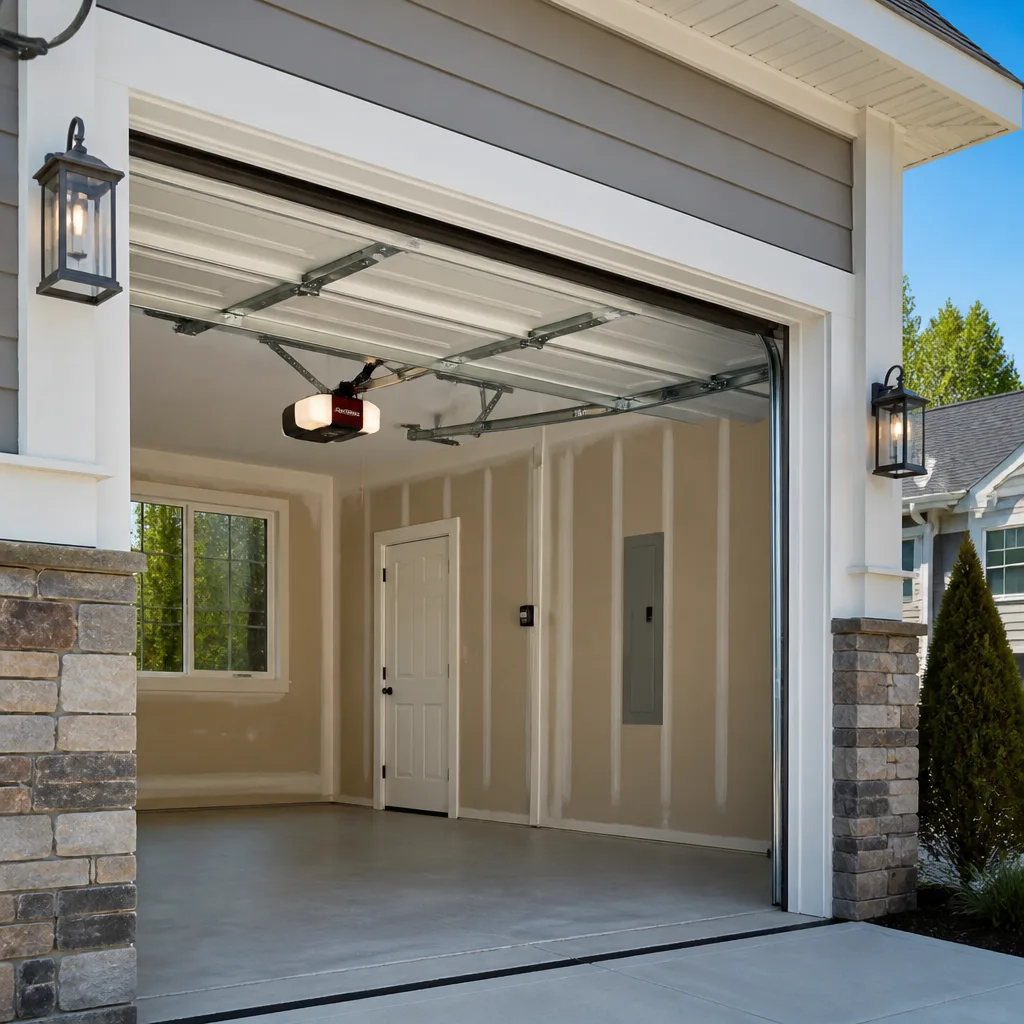 LiftMaster openers
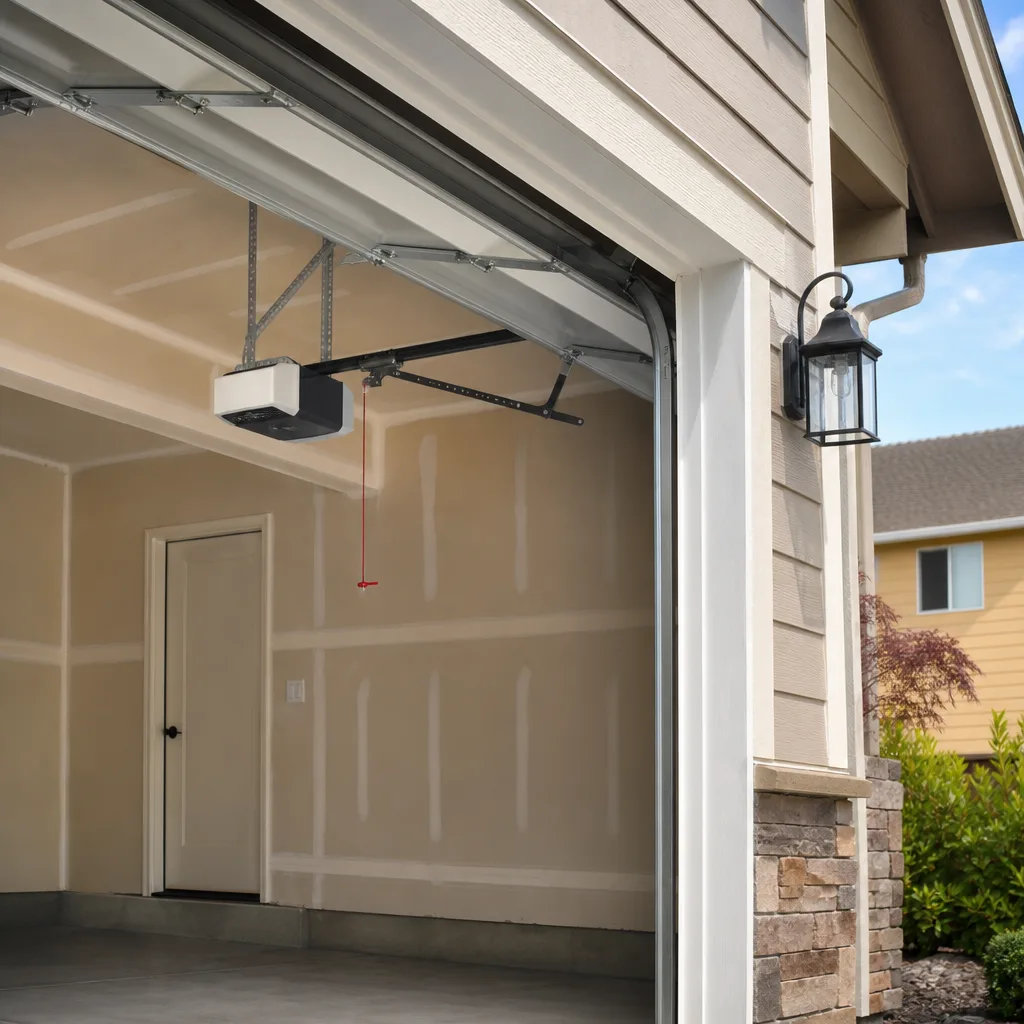 Chamberlain openers
Full 25-point door and opener safety check with every visit - springs, cables, rollers, tracks, and your LiftMaster or Chamberlain opener included
You get a price before we start. It does not change when the truck arrives.
Get your free estimateGarage Door Warning Signs: A Houston Homeowner’s Reference Guide
A garage door that shudders on the way up isn’t a minor annoyance. It’s a spring or cable under uneven load, and uneven load is how a 400-pound door comes off its tracks. Most Houston homeowners don’t realize their door spent three weeks telling them something was wrong before it finally gave out on a Monday morning with the car trapped inside. This guide translates the eight most common early-warning signals into plain language, and gives you a clear triage for each one: handle it yourself, schedule a service call, or stop using the door right now. For a broader overview, see our The Complete Guide to Garage Door in Houston.
Quick Answer
Most garage door failures in Houston announce themselves days or weeks in advance through specific sounds, visible wear on springs and cables, and changes in how the door moves. The warning signs that matter most are grinding or popping noises, a door that hesitates or shakes, visible gaps in torsion springs, frayed cables, and a door that reverses or sags when opening. If you hear a loud bang or see a snapped cable, stop using the door immediately and call a professional.
Styles & brands we work with
Table of Contents
- The Four Noise Signatures That Map to Specific Failures
- Visual Inspection Points on the Spring and Cables
- Movement Warning Signs: Hesitation, Shudder, and Sag
- How Houston Humidity Compresses the Warning-to-Failure Timeline
- The Three-Level Triage Framework for Every Warning Sign
- How to Document Warning Signs Before You Call
- Warning Signs Specific to Garage Door Openers
- Seasonal Patterns Houston Homeowners Should Know
The Four Noise Signatures That Map to Specific Failures
Your garage door has a vocabulary. It uses four distinct sounds to tell you what’s failing, and each one points to a different repair. Learning the difference between a grind, a squeal, a pop, and a bang is the single most useful diagnostic skill a Houston homeowner can have because it tells you whether you have a $15 roller problem or a $450 spring replacement before anyone ever steps foot in your garage.
Grinding: Roller Wear
A grinding noise during operation almost always means your rollers are worn. Rollers are the small wheels that ride inside the vertical and horizontal tracks, and they come in two quality tiers. Cheap rollers have steel wheels with no bearings, and once the steel starts grinding against the track, you get that rough, metal-on-metal sound. Nylon rollers with sealed bearings run quieter and last longer, but they still wear out. In Houston, the humidity accelerates corrosion on the bearing seals, so rollers that would last seven years in a dry climate often fail in four or five here. If you hear grinding, check whether the noise follows the door through its full travel or only happens in certain sections of track. Consistent grinding means roller replacement, which is a straightforward repair. Grinding that changes pitch or intensity at specific points means track misalignment is also in play, and you should stop using the door until it’s inspected.
Squealing: Dry Hinges and Bearing Plates
Squealing is the sound of metal parts moving without lubrication. On a garage door, the usual culprits are hinges and the bearing plates at the ends of the torsion spring shaft. The fix is often as simple as applying a silicone-based lubricant to the hinge pins and spring bearings, but the key word is silicone. WD-40 is a solvent, not a lubricant, and it will make the noise worse within a week. In our experience, Houston homeowners who lubricate their hinges twice a year, once in spring and once in fall, get noticeably longer life out of their hardware. For a full maintenance calendar, see Seasonal Garage Door Care for Houston: Year-Round Homeowner’s Guide. If the squeal persists after proper lubrication, the hinge may be worn to the point where the pin is loose in the barrel, and replacement is the only fix that lasts.
Popping: Spring Tension Irregularity
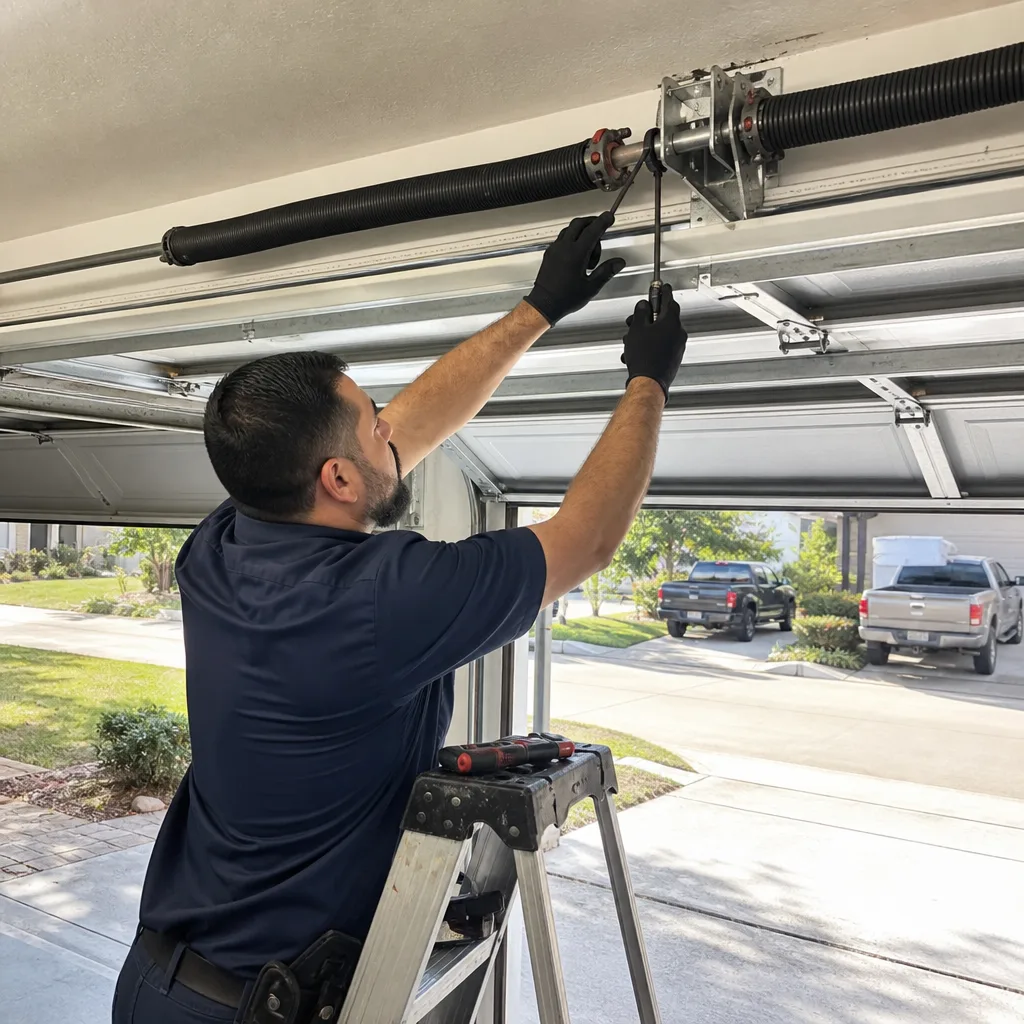
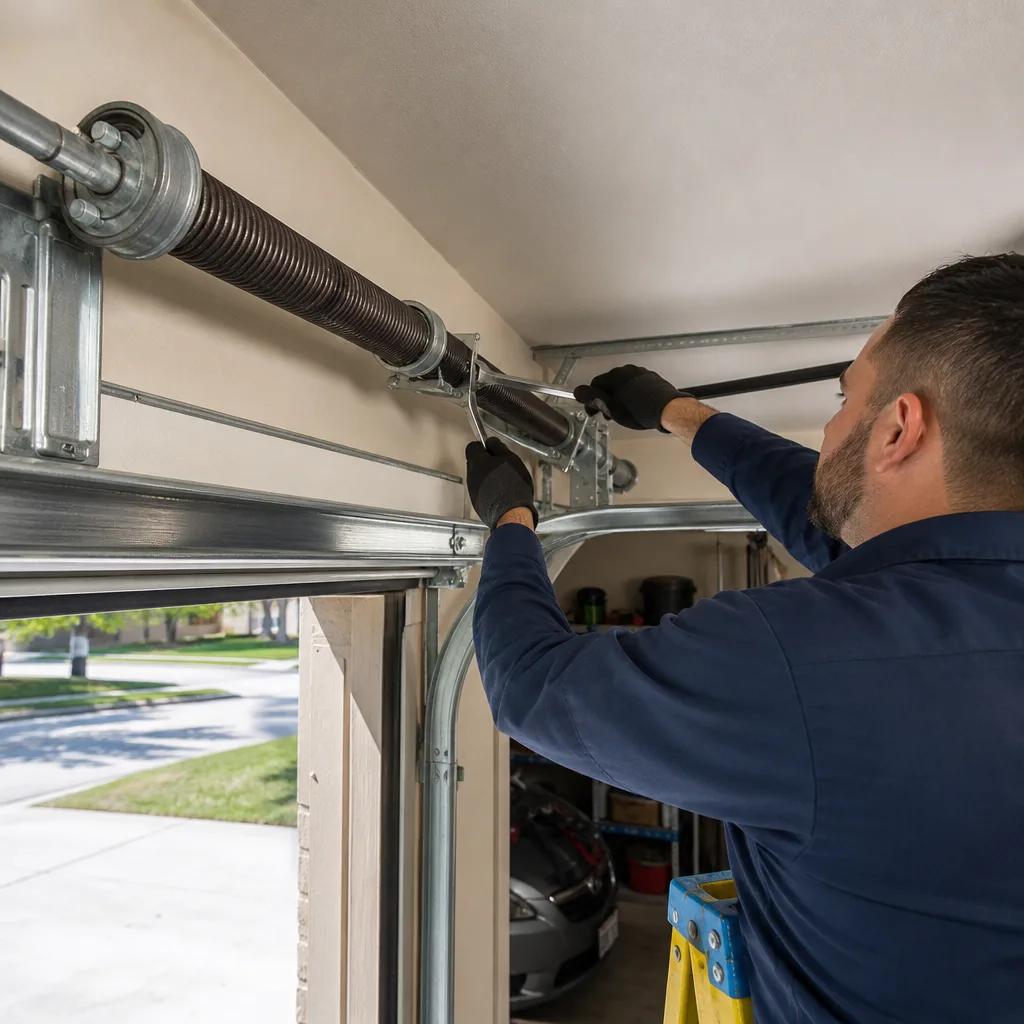
A popping sound, especially when the door opens, usually traces back to the torsion spring, which is the thick coiled spring mounted above the door that bears most of the lifting load. When a torsion spring is under uneven tension, or when sections of the coil begin to bind against each other, you’ll hear sharp popping as the spring unwinds. This is an early indicator of spring fatigue. Given enough cycles, every torsion spring breaks, and the popping is the sound of the spring beginning to let go. If you hear popping consistently, you’re likely within weeks or months of a broken spring, and since Houston garages get used multiple times a day, the cycle count adds up faster than most homeowners expect. Schedule a service call now, before the spring fails while your car is on the wrong side of the door.
Banging: Cable Jump or Drum Slip
A loud bang, or a series of bangs, is the most serious noise in the garage door vocabulary. This is typically a cable jumping the drum, the grooved wheel at the end of the torsion bar that guides the lifting cables. When a cable comes out of its groove, the tension on that side of the door changes instantly, and the door can drop or bind. A bang can also signal a roller snapping out of the track. Either way, this is a stop-using-the-door-immediately situation. The cables on a torsion spring system are under enough tension to cause serious injury if they snap, which is why cable work is never a DIY job. Call a professional the same day.
Visual Inspection Points on the Spring and Cables
You don’t need to touch anything to learn a lot about your garage door’s health. Standing safely on the ground, with the door closed, you can check three critical components in under five minutes. The rule for safe inspection is simple: look, don’t touch. If you have to reach, use a ladder, or put your hands anywhere near the spring or cables to see something, stop looking and call someone. The distance rule we tell our customers: if you can’t see it clearly from where you’re standing, it’s close enough to be dangerous to inspect.
How to Check the Torsion Spring Safely
- Close the door completely and stand inside the garage, looking up at the horizontal metal bar above the door opening.
- Find the torsion spring, a thick coiled spring or pair of springs wrapped around that bar.
- Look for a visible gap anywhere in the coil. A healthy spring has no gaps. A gap means the spring has snapped, even if part of it still looks intact.
- Check both ends of the spring where it meets the stationary cones. Rust or a reddish-brown powder around the cones indicates the spring is corroding and losing strength.
- If you see two springs and only one is in one piece, the other has broken. Stop using the door and call for replacement, because the remaining spring is now carrying double the load and will fail soon.
How to Check the Cables from the Ground
- Look at the vertical tracks on both sides of the door. The lifting cables run inside or alongside these tracks.
- Check for fraying. A cable that is starting to fail looks like a rope with individual wire strands poking out, not a smooth, solid line.
- Look at the cable drum, the grooved wheel at the top corner of the door where the cable wraps. The cable should sit cleanly in the groove. If it’s riding up over the edge, that’s a misalignment problem.
- Compare both sides. If one cable looks tighter or thinner than the other, or if one side of the door hangs slightly lower when partially open, you have an uneven load issue.
- Do not touch any cable or attempt to reposition it. Cables under tension can cut and snap. If you see any of these signs, call for professional service.
The Red Rust Signal
Houston’s humidity leaves a specific calling card on garage door hardware: red rust. If you see reddish-brown corrosion on the spring, hinges, or cable anchoring points, that’s not a cosmetic issue. Rust on a torsion spring means the metal is oxidizing from the outside in, and the spring’s rated cycle life drops with every month of exposure. A spring that would have lasted 10,000 cycles in a dry storage unit might fail at 7,000 cycles in an unconditioned Houston garage. If you see red rust, factor it into your decision timeline. The door isn’t failing yet, but it’s aging faster than the calendar suggests.
Movement Warning Signs: Hesitation, Shudder, and Sag
Beyond sound, your door’s movement tells you a lot. Most people notice the noise first, but the visual symptoms often appear earlier and are easier to interpret. Three movement patterns deserve your attention: hesitation at the start of travel, shudder or shake during travel, and sag on one side when the door is fully open.
Hesitation at the Start of Travel
When you press the opener button and the door pauses for a beat before it starts moving, or it moves an inch and stops before continuing, you’re watching the spring work harder than it should. A properly balanced door starts moving smoothly from the moment the opener engages. Hesitation means the spring has lost tension and the opener motor is having to muscle the door off the ground by itself. That’s not what the opener is designed to do. Running the opener against a weak spring overworks the motor, shortens the opener’s life, and eventually burns out the drive gear. If you notice hesitation that develops over a few weeks, the spring is the likely culprit, not the opener.
Shudder or Shake During Travel
A door that shudders or visibly shakes as it moves is telling you something about the load distribution. The most common cause is a spring that is wearing unevenly, so one side of the door carries more weight than the other. The second most common cause is a bent track or a roller that is binding in a section of the track. In Houston, where foundation settlement is common due to expansive clay soils, tracks that were once perfectly aligned can shift as the garage slab moves. A door that shudders is applying uneven stress to every component in the system, and running it repeatedly in that condition shortens the life of the panels, hinges, and rollers. This is a schedule-within-30-days situation unless the shudder is severe enough to see the door wobble from across the room, in which case, stop using it.
Sag on One Side When Open
If you open the door fully and one side hangs an inch or more lower than the other, you have a cable or spring balance problem. The simplest test is to raise the door manually, with the opener released using the red emergency cord, and look at the bottom edge from inside the garage. A properly balanced door sits level, or within a quarter inch of level. Sag means one cable has stretched, one spring has weakened, or a drum has slipped. This is a condition that will get worse every time the door cycles, and it usually ends with a cable break if it isn’t addressed. Schedule a service call this week.
How Houston Humidity Compresses the Warning-to-Failure Timeline
Every garage door component has an expected lifespan, but those lifespans are calculated for ideal conditions. Houston is not ideal conditions. The combination of high humidity, salt in the air from the Gulf, and temperature swings between 40 and 100 degrees means the same spring that would give a Phoenix homeowner years of warning before failure gives a Houston homeowner months. The practical rule for Houston: when you notice a warning sign, cut the recommended service timeline in half.
Humidity attacks garage door hardware in three specific ways. First, it accelerates oxidation on torsion springs, which is the primary driver of premature spring failure. A corroded spring doesn’t just look bad; the rust creates micro-pitting on the coil surface, and every pit becomes a stress point where a crack can start. Second, humidity swells and accelerates wear on nylon rollers, so the warning period between “that sounds a little rough” and “the roller just shattered” is shorter. Third, humidity in the air works its way into lubricant, breaking it down faster, which means the squealing and grinding stages of hinge and bearing wear arrive sooner and progress faster than in a dry climate.
In peak summer, when Houston garages regularly stay above 90 degrees even at night, the thermal cycling also matters. The door is hottest in the late afternoon and coolest just before dawn, and that daily expansion and contraction stresses every metal component. If you notice a new sound or movement symptom, don’t wait three months to see if it gets worse. In Houston, three months of daily temperature swing and humidity exposure is enough time for a minor symptom to become a major failure.
The Three-Level Triage Framework for Every Warning Sign
Every warning sign in this guide falls into one of three categories. The point is not to diagnose the exact part that’s failing, which takes a pro, but to decide what you do this week. Here’s the framework, applied to the symptoms we’ve covered.
Level 1: Safe to Monitor
- Mild squealing that resolves after lubrication. Lubricate the hinges and spring bearings with a silicone-based product. If the noise returns within a month, move to Level 2.
- Light surface rust on non-structural hardware, like hinge brackets or track bolts. Note it, photograph it, and check again in 60 days.
- A door that runs slightly slower in cold weather. Springs and rollers are stiffer at low temperatures. If the door returns to normal speed when it warms up, it’s a seasonal variation, not a failure.
- Visible wear on the door’s weatherstripping. This is a seal issue, not a mechanical problem, but it needs replacement eventually to keep Houston’s humidity out.
Level 2: Schedule Service Within 30 Days
- Consistent grinding during operation. Rollers are wearing, and the alternative is metal shavings inside the tracks, which accelerate track wear.
- Hesitation at the start of travel. The spring is likely losing tension, and every cycle puts the opener motor under more strain.
- Mild shudder that doesn’t worsen day to day. You have a developing balance or track issue, and the repair is cheaper now than after it cascades.
- Visible red rust on the torsion spring. The spring hasn’t failed, but its life is shrinking. Replacement on your schedule is better than replacement on the spring’s schedule.
- Popping sounds during operation. A spring is binding or losing tension. Waiting turns a $300 spring job into a day where your car is stuck.
Level 3: Stop Using the Door Immediately
- A loud bang followed by uneven operation or failure to open. A cable has jumped the drum or a spring has snapped. Continuing to cycle the door risks pulling it off the tracks.
- A snapped cable. You’ll see a loose, dangling cable on one side. Do not attempt to reattatch it. The other side is still under full tension and can fail at any moment.
- A door that falls when you close it manually. In a balanced door, the spring carries the weight. If the door drops, the spring has broken, and the door weighs 150 to 400 pounds depending on size and material.
- A door that comes off one track. It’s already tilting, which means the cables and rollers on one side are carrying an unstable load. Do not try to push it back on.
- Any situation where you see the spring in pieces. Even if the other spring looks fine, the remaining spring is loaded beyond its rating. The door can move unpredictably.
How to Document Warning Signs Before You Call
When you call a garage door company and say “it’s making a weird sound,” you’re giving up control of the diagnosis. A salesperson who hears that knows they’re not competing against another bid; they’re competing against your uncertainty. When you call and say “there’s a quarter-inch gap in the torsion spring and a grinding sound that follows the door through the middle third of travel,” you’ve just told them you know something, and the bid you get will reflect it. Here’s how to document warning signs like a contractor would.
Step 1: Photograph the Spring and Cables
Take clear photos of the torsion spring, the cables, and the rollers. Use your phone’s flash. Get close enough that the detail is visible, and take the same shot from the same angle every time you check. A series of photos taken two weeks apart shows whether a gap is widening or a rust patch is spreading, and it gives a technician more diagnostic information than any verbal description.
Step 2: Record the Sound
Most smartphones capture garage door noises clearly if the phone is held a few feet from the door track. Record the door operating in both directions. Note the date and whether the noise was consistent or intermittent. A 20-second recording eliminates the guesswork for the technician and gives you a baseline for comparison later.
Step 3: Track the Dates
Write down the date you first noticed each symptom, even just in a note on your phone. “Grinding started around March 10; louder by March 24” is genuinely useful for diagnosis. It tells the person quoting the job whether the problem is progressing slowly or quickly, and that information should change the urgency of your scheduling.
Step 4: Note the Conditions
Houston weather affects door behavior. If the shudder only happens after a heavy rain, or the squeal is worse when the garage is hot, write that down. Moisture-sensitive symptoms point to specific causes, like failing seals or humidity-swollen components, and knowing the pattern helps avoid replacing parts that aren’t the actual problem.
One more thing worth saying plainly: when you present documented symptoms, you’re more likely to get a quoted price instead of a vague estimate. A technician who sees photos and hears a recording knows what the job is before they arrive, and they can give you a number on the phone. At Brock Garage Doors Houston, we ask for photos and recordings for exactly this reason. The written price you get before any work starts is more accurate when we know what we’re walking into, and you keep control of the conversation from the first call.
Warning Signs Specific to Garage Door Openers
Openers fail differently than mechanical door components, and the warning signs are easy to misread because they often look like door problems. An opener that runs but doesn’t move the door could be a stripped drive gear inside the opener, or it could be a broken spring that’s disconnected from the door’s weight. Here’s how to tell the difference without taking anything apart.
The Opener Runs but the Door Doesn’t Move
If you hear the opener motor running but the door stays put, disconnect the opener using the red emergency release cord and try to lift the door manually. If the door is heavy and won’t open by hand, you have a broken spring, and the opener was never the problem. If the door opens easily by hand, the issue is inside the opener, most commonly a stripped drive gear on a chain-drive unit or a broken belt on a belt-drive model. Both repairs are straightforward, and on units from major brands like Chamberlain, LiftMaster, or Genie, parts are usually available same day.
The Door Reverses Before Reaching the Floor
When a door starts closing and then reverses on its own, the safety sensors, the small photo-eye units on either side of the door near the floor, are usually the culprit. They either lost alignment or the lenses have accumulated dust. A quick cleaning and realignment often fixes it in five minutes. But if the sensors are clean and aligned and the door still reverses, the opener’s force setting may be reading too much resistance, which can be caused by a door that’s binding in its tracks or a spring that’s failing. That’s a Level 2 situation: schedule service within a month.
The Opener Runs After the Door Stops Moving
If you hear the motor continue to run for a second or two after the door has reached full open or full close, the limit settings may be off, or the opener’s internal gear is slipping. Limit issues are an easy adjustment on most models. Gear issues get worse quickly. If you ignore it, you’ll eventually hear the motor run and see nothing move at all, which is the stripped gear failure. Replacing the gear before it fails completely is cheaper and faster than the service call you’ll make when the door is stuck halfway open.
Openers from Craftsman and Raynor units, along with the more common Chamberlain and LiftMaster models, share similar failure modes, so the triage is the same regardless of brand. If the opener is more than 12 years old and showing multiple symptoms, replacement is almost always a better value than repeated repairs. Our Garage Door Opener Repair in Houston page covers opener-specific troubleshooting in more detail.
Seasonal Patterns Houston Homeowners Should Know
Garage door failures in Houston don’t distribute evenly across the year. The pattern follows the weather, and knowing the pattern helps you catch problems before they catch you. Two times of year matter most: the summer heat peak and the first cold snap of winter.
Summer: The Spring Killer
Houston summers break torsion springs. The heat itself isn’t the direct cause, but the daily expansion and contraction cycle is the stressor. A garage that’s 60 degrees at dawn and 100 degrees by mid-afternoon goes through a 40-degree thermal swing every single day. The metal in a torsion spring expands and contracts with every swing, and the cumulative effect over a three-month Houston summer is equivalent to years of aging in a stable climate. Most of the broken springs we replace in Houston happen between June and September, and the mechanics are straightforward: Houston’s pattern of intense afternoon heat followed by overnight cooling, combined with humidity that keeps the garage hot well past sunset, accelerates the metal fatigue that eventually snaps the coil.
Winter: The Roller and Track Season
Houston winters are mild by national standards, but cold fronts bring what matters most to rollers and hinges: temperature drops into the 30s and 40s, often with rain. The temperature change makes lubricant thicken, which increases friction on every moving part. If the rollers are already worn, the added friction is often enough to cause a roller to seize or the opener to strain. The first cold week of Houston’s short winter season usually brings a cluster of service calls for doors that were fine all fall and suddenly started grinding or refusing to open. Catching roller and lubrication problems in the fall, before the cold front hits, is the cheapest preventive maintenance available.
The Rain Factor
Houston’s rainfall patterns deserve a word. When the soil around your foundation swells after heavy rain, especially in older neighborhoods with expansive clay soils, the garage slab can shift slightly. A slab that moves a fraction of an inch is enough to throw your tracks out of square, and the first symptom is usually a door that drags or shudders on one side. If you notice new movement symptoms in the days or weeks after a heavy rain, foundation movement is a possibility worth mentioning to your technician. For broader Houston repair context, start with Garage Door Repair in Houston.
Common Mistakes to Avoid
- Lubricating the wrong parts with the wrong product. Garage door tracks should not be lubricated, and WD-40 is not a lubricant for door hardware. Spraying the track attracts Houston dust and humidity, creating a paste that accelerates roller wear. Use silicone spray on hinges, springs, and bearing plates only.
- Attempting to adjust or replace a torsion spring yourself. Torsion springs are under enough tension to break bones or cause fatal injuries. Even with online tutorials, the tools and technique required are beyond what a homeowner should attempt. This is a job for a trained professional, every time.
- Ignoring a new sound until it becomes a failure. Every noise described in this guide is a cheap repair waiting to become an expensive one. A $15 roller job ignored becomes a $300 track replacement and a day without your car. In Houston’s climate, the window is short.
- Using the opener after the door has been manually disconnected without reconnecting it properly. If you’ve released the emergency cord and the door won’t re-engage when you run the opener, don’t force it. The carriage needs to reconnect to the rail, and forcing it can bend the release mechanism. Call for service if it won’t click back in.
- Releasing the opener while the door is partway up, then trying to close it manually without knowing whether the spring is intact. A door that’s been disconnected from the opener with a broken spring is a free-falling weight. If the door feels heavy or drops when you try to guide it down, release it and get clear, then call a professional.
- Deferring maintenance for years and expecting the door to fail gracefully. Everything in a garage door system wears on a schedule, and Houston accelerates that schedule. A five-minute monthly visual check catches most problems in the Level 1 or Level 2 stage, when the fix is quick and cheap.
- Assuming a new door means a problem-free decade. Even new doors have break-in periods, and a new door installed on old tracks or with an aging opener carries the old problems into the new setup. If you’re replacing a door in Houston, have the springs, cables, and rollers evaluated at the same time.
See the difference
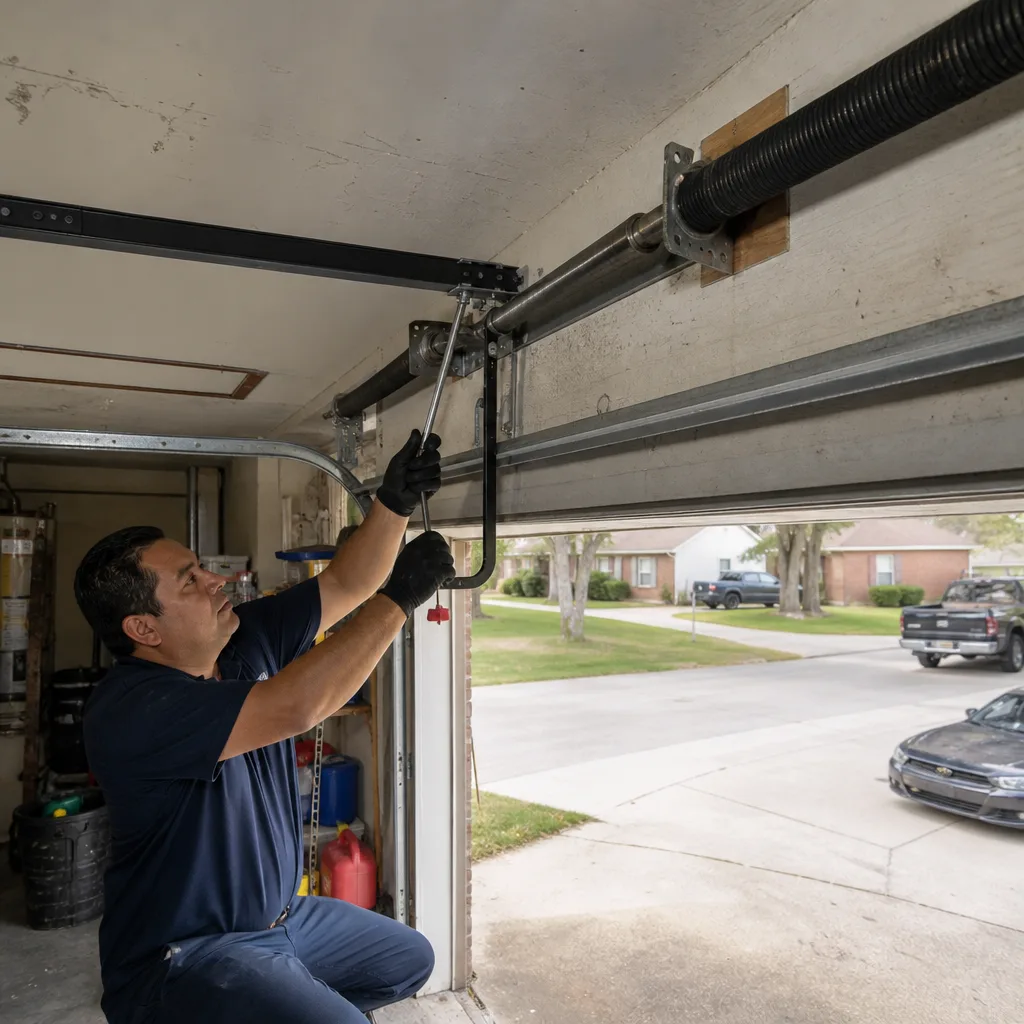 Before
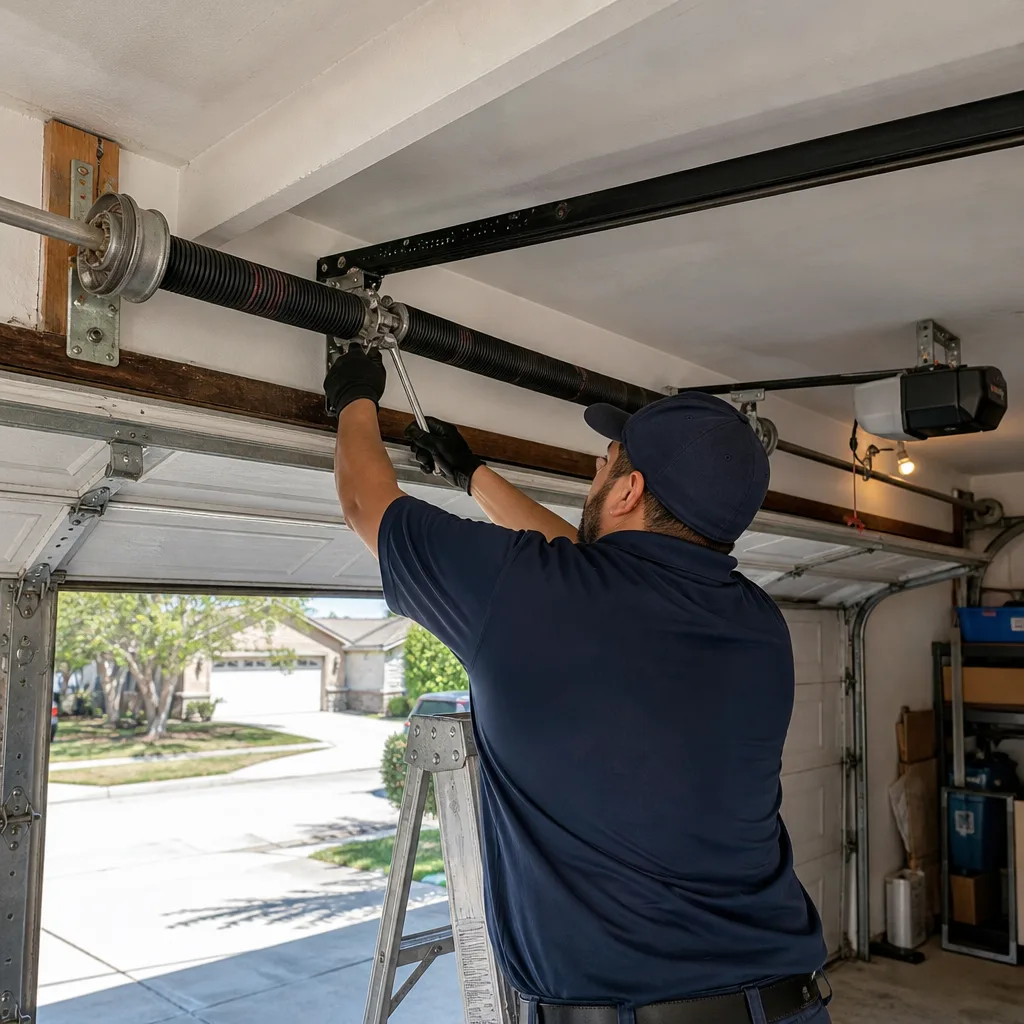 After
After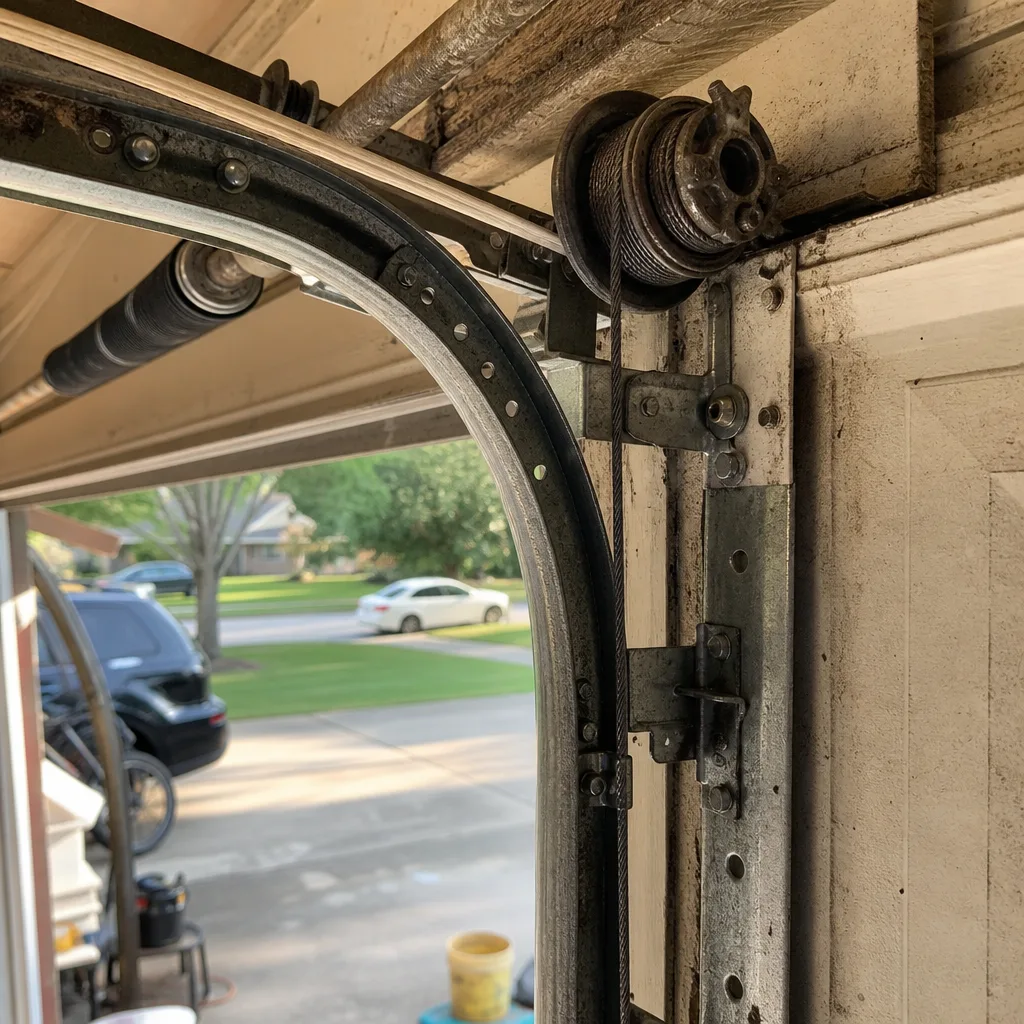 Before
 After
After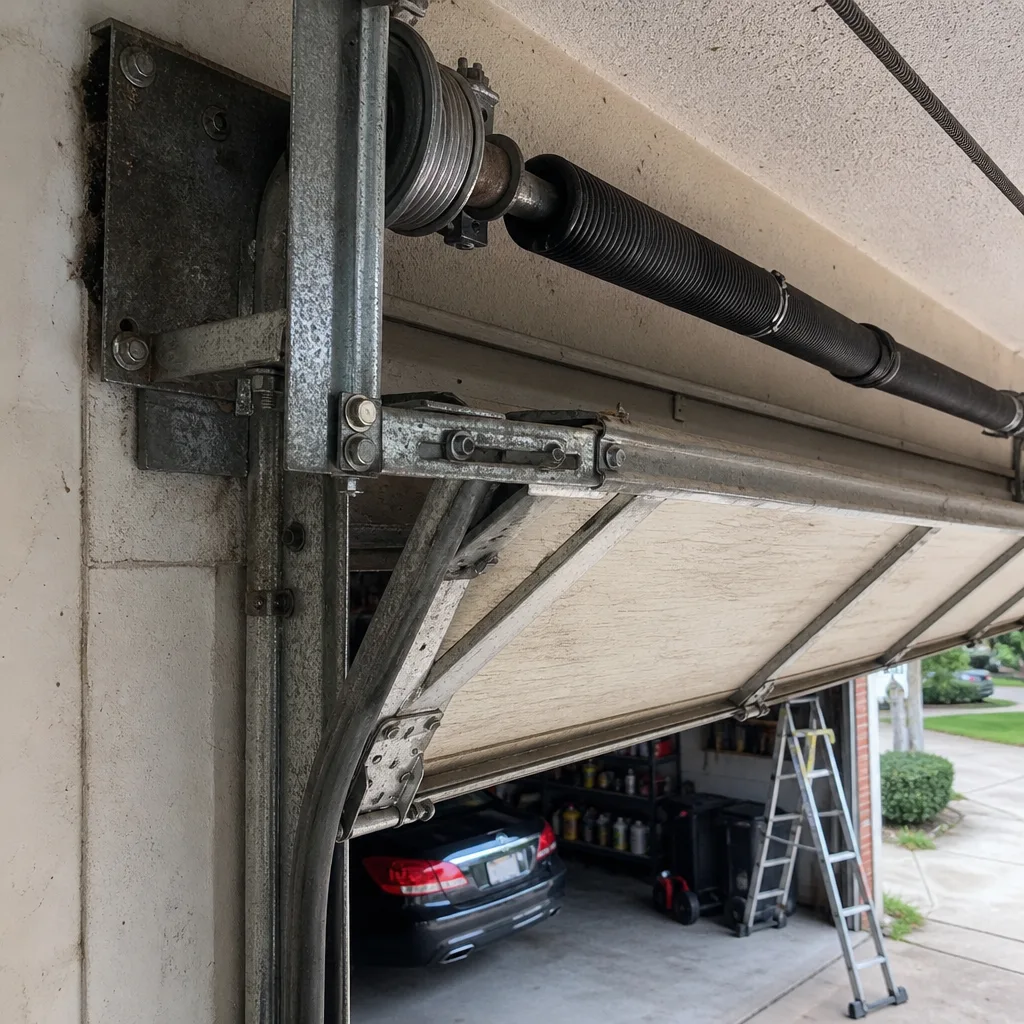 Before
 After
AfterWhen to Call a Professional
Call a professional when you see a snapped cable, a gap in a torsion spring, a door that has come off a track, or when you hear a loud bang during operation. Call when hesitation, shudder, or grinding persists after basic lubrication. Call when the warning sign you’ve documented is getting worse week over week, not better. Most importantly, call before the door fails completely, because an emergency call at 6 a.m. with your car trapped inside always costs more than the same repair scheduled a week earlier. Brock Garage Doors Houston offers free estimates in Houston, and a live person answers the phone 24 hours a day, including weekends and holidays. Call (325) 308-2009 with your photos and a description of the symptom, and we’ll give you a written price before any work begins.
We service all eight major brands, including Amarr, Wayne Dalton, and Raynor doors, and every repair is covered by our 365-Day Done Right Promise in writing. If the repair fails within a year, we return at no charge. Wade Mercer, who owns and operates Brock Garage Doors Houston home, holds every job to The Garrison Standard: arrival window honored, price in writing before any work starts, job done by the book, site left clean, and a full-year written guarantee on every repair.
Frequently Asked Questions
A torsion spring about to break typically shows a visible gap in the coil, heavy red rust near the cones, or a popping sound during operation. If your door hesitates at the start of travel or feels heavier than it used to when you open it manually, the spring has already lost tension and failure is closer than you think. In Houston’s climate, a spring showing these signs may fail within weeks. Call (325) 308-2009 for an inspection quote, and we’ll give you the number in writing before any work starts.
Shudder usually means the door is under uneven load, most often from a weakening spring on one side or a track that has shifted out of alignment. In Houston, foundation movement after heavy rain can cause track misalignment that shows up as a shudder. A door that shudders is putting stress on every component, and ignoring it turns a spring or track job into a multi-part repair.
Sometimes, but it depends on the cause. If the cable frayed because of corrosion or normal wear and the spring is still in good condition with documented cycle life remaining, the cable can be replaced on its own. If the cable snapped because the spring broke first, which is common, replacing only the cable leaves the root cause unaddressed and the door unsafe. Most cable repairs in Houston run $150 to $275, depending on cable type and drum condition. See Garage Door Cable Repair in Houston for the full breakdown.
Houston’s humidity accelerates oxidation on steel springs, which creates micro-pitting on the coil surface and reduces the spring’s cycle life. The combination of Gulf moisture, high heat, and daily temperature swings means spring wear that would take years in a dry climate often happens in months here. That’s why the same warning sign that’s a 90-day problem in Phoenix is often a 30-day problem in Houston.
Visual inspection from the ground is safe if you follow one rule: look, don’t touch. If you can’t see something clearly without reaching, climbing, or touching the spring or cables, stop and call a professional. Cables and torsion springs are under enough tension to cause serious injury if they fail while you’re near them. The inspection points in this guide are all visible from a standing position with the door closed.
A loud bang followed by abnormal operation usually means a cable has jumped its drum or a spring has snapped. Stop using the door immediately. Do not attempt to open it manually or re-engage the opener. Leave the door in whatever position it’s in and call a professional the same day. Continuing to cycle the door risks pulling it off the tracks, which turns a spring replacement into a full door replacement. Call (325) 308-2009 and a real person will answer.
The Bottom Line
Your garage door warns you before it fails. The noise it makes, the way it moves, and what you can see on the spring and cables are all signals, and each signal maps to a decision: monitor it, schedule service, or stop using the door now. Houston’s climate compresses the timeline, so a symptom that’s mild today may be a failure in 30 days. Document what you see and hear, put the triage framework to work, and when the signal says call, call early. Explore more guides & resources to keep your door running smoothly year-round. A scheduled spring replacement on a Tuesday afternoon always beats a stuck door on a Monday morning, and the written price you get before any work starts should be the same number on the invoice when the job is done.
Written by Wade Mercer, Owner at Brock Garage Doors Houston, serving Houston since 2001.